
Last Updated Jan. 15, 2026, 9:26 AM
The United States has crossed a decisive threshold in its long confrontation with Venezuela. After months of military buildup in the southern Caribbean — including deploying an aircraft carrier strike group — and lethal strikes on suspected narco-trafficking vessels, U.S. forces conducted an operation on Jan. 3, 2026, that resulted in the capture of Venezuelan President Nicolás Maduro, abruptly ending the dictator’s rule, but leaving the rest of the regime largely intact.
Washington has framed the operation as the culmination of a pressure campaign against transnational criminal networks embedded within the Venezuelan state and as an opportunity to gain access to the country’s natural resources. But Maduro’s removal shifts the central question from escalation to aftermath: focused on how the United States intends to manage potential political transition, security, and legitimacy in a country already afflicted by economic collapse, mass emigration, and armed non-state actors.
For regional governments, U.S. allies, and strategic competitors alike, attention has now turned to what comes next in Venezuela and the Western Hemisphere more broadly, and whether the intervention produces stabilization or a prolonged period of uncertainty.
Venezuela’s status as home to the world’s largest proven oil reserves — and the Trump administration’s statements about controlling and marketing that oil indefinitely — have made energy policy as central to the post-intervention transition as political reconstruction.
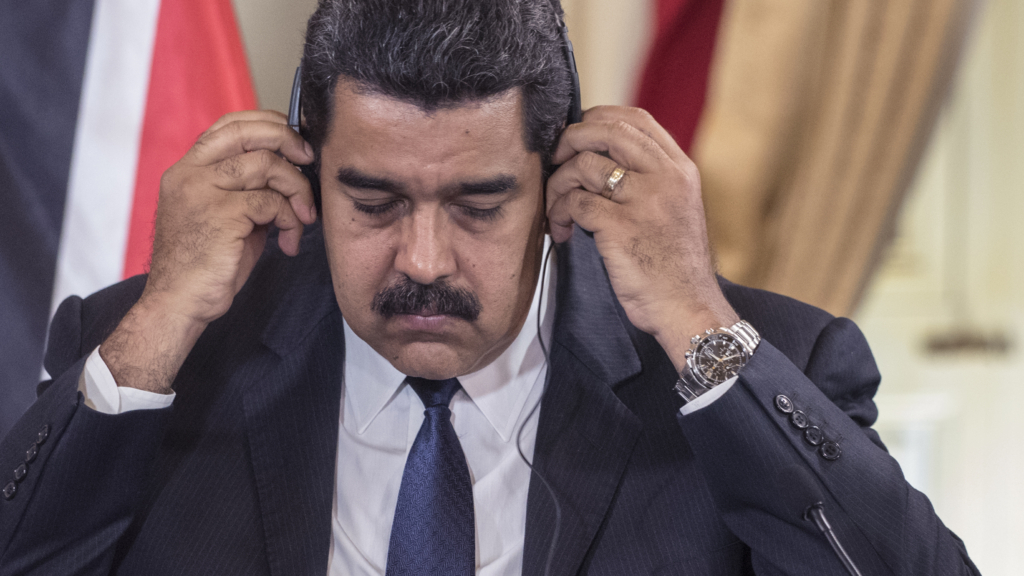
Image: Eneas De Troya via Wikimedia Commons
Key Takeaways
- Maduro’s fall has elevated Delcy Rodríguez as acting president of Venezuela, with other key regime figures also remaining in place.
- Washington is maintaining coercive pressure on Caracas in the form of a partial blockade and threat of further military action to comply with U.S. demands.
- Investing in and rebuilding Venezuela’s energy sector — including plans to sell stored crude and involve U.S. energy firms — is central to U.S. strategy.
- Legal justifications tied to counter-narcotics and terrorism for the Maduro operation and lethal strikes on drug vessels continue to be contested.
Table of Contents
- Historical Background & U.S. Policy
- U.S. Operation in Venezuela
- Venezuela After Maduro
- Drug-Trafficking, Sanctions, and Regime Pressure
- Regional and International Implications
- What Analysts Debate
- Further Reading
- FAQs
Historical Background & U.S. Policy
U.S.-Venezuelan relations have deteriorated since former Venezuelan President Hugo Chávez’s rise in 1999 and Maduro’s consolidation of power since 2013. Over the past decade, Maduro oversaw deeply contested elections in 2018 and 2024, further dismantled democratic institutions, and presided over economic collapse and mass emigration.
For years, the United States has imposed targeted sanctions on Venezuelan officials and state-linked entities — steadily expanding them in response to democratic backsliding, corruption, and human-rights abuses — and stopped recognizing Maduro as Venezuela’s legitimate president in 2019, instead backing opposition leaders who claimed to have won disputed elections.
In 2025, Washington designated the so-called “Cartel of the Suns,” purportedly led by Maduro, and Tren de Aragua as foreign terrorist organizations and placed renewed focus on the Western Hemisphere as a strategic priority — from Greenland to Argentina — amid growing Chinese and Russian influence in the region.
U.S. Operation in Venezuela
The Maduro operation in Caracas followed months of heightened tensions between Washington and Caracas.
Since August 2025, the United States has positioned substantial air, naval, intelligence, and special operations assets in the region, supported by existing bases in Puerto Rico and Guantánamo Bay, and expanded access agreements with regional partners.
In October 2025, President Donald Trump authorized CIA operations inside Venezuela, increasingly hinted at possible land strikes, and imposed a partial blockade on sanctioned oil tankers leaving the country.
After off-ramps were not taken by Maduro, U.S forces struck military targets and captured the dictator and his wife in a stunning nighttime raid that exhibited cyber, intelligence, and operational dominance in a mission designed to seize the leader while avoiding large-scale ground combat.
Venezuela After Maduro
Maduro’s removal has largely left the remainder of Venezuelan leadership untouched. While Caracas previously tried to project resolve, the immediate aftermath has been marked by efforts to contain the fallout of Maduro’s ouster while also abiding by the Trump administration’s demands.
Key uncertainties center on the cohesion of the Venezuelan military, the role of militias and security services, and whether remaining elites can coalesce around Delcy Rodríguez. The risk of localized violence, criminal opportunism, and institutional collapse remains high, particularly given the state’s weakened capacity.
For Washington, the challenge now lies less in regime change than in preventing Venezuela from sliding into further chaos — with U.S. intelligence assessments suggesting regime loyalists would provide more stability in the near term than alternatives such as opposition leader María Corina Machado.
Drug-Trafficking, Sanctions, and Regime Pressure
Washington links recent military activity to Venezuelan elites’ alleged involvement in narco-trafficking, particularly Tren de Aragua and the Cartel of the Suns — though experts argue it is not a formal organization like cartels in Colombia and Mexico. Experts have questioned the legal elasticity of that framework, particularly as it expanded from financial measures to kinetic action.
Before 2025, sanctions and interdiction aimed to cut illicit revenue and weaken the regime’s loyalty network. With Maduro removed, unresolved questions remain about precedent and the boundaries between counter-narcotics, counter-terrorism, foreign intervention, and what comes next.
Following the Maduro operation, Washington has indicated it may lift sanctions on Venezuela to facilitate oil sales.
Regional and International Implications
Despite its questionable legality, the intervention initially generated some cautious optimism throughout the region that Maduro’s fall could spell the end to a brutal regime notorious for its repression and mismanagement — potentially allowing for democratization. But with the authoritarian regime still in place and the political opposition sidelined, many question Washington’s endgame and fear Maduro’s removal could still yet destabilize the country and region, intensify migration flows, and further damage Venezuela’s economy if mismanaged further.
Regional governments were largely shocked by the U.S. operation — though reactions varied widely — and subsequent comments by Trump suggesting the United States might take action against other countries in the region raised alarm from Greenland to Cuba and beyond. Strategically, the operation also forces China, Russia, and Iran to reassess their posture in the hemisphere and the durability of their partnerships with authoritarian governments.
What Analysts Debate
With Maduro removed, analysts are no longer debating whether the United States will intervene, but whether it can define and sustain a viable end state in Venezuela. Core disagreements center on how involved Washington will be in Venezuela politically, economically, and militarily moving forward as well as when a democratic transition might take place.
Key questions also persist regarding the legality of the operation, long-term strategy, and future U.S. activity in the region.
Further Reading
- “Trump’s Venezuelan Regime Change: Why Do People Keep Getting Him Wrong on Foreign Policy?” by Ryan Evans
- “Maduro Captured in Caracas,” with Henry Ziemer and Nicole Wiley (Members Only)
- “The Immediate Aftermath of the U.S. Operation in Venezuela,” with David Smilde and Joseph Wehmeyer (Members Only)
- “After Maduro: Trump’s Managed Authoritarianism Trap in Venezuela,” by Orlando J. Pérez
- “The Legal Implications of Maduro’s Capture,” with Scott Anderson and Kerry Anderson (Members Only)
- “Assessing the Capabilities of Venezuela’s Military and Armed Groups,” with John Polga-Hecimovich and Kerry Anderson (Members Only)
- “Weak in Battle, Dangerous in Resistance: Venezuela’s Military Preparedness and Possible Responses to U.S. Action,” by John Polga-Hecimovich
- “The Day After: What Successful Regime Change in Venezuela Would Really Take,” by Orlando J. Pérez
- “Is Strategy Possible Now? Ever?” with Frank Hoffman, Justin Logan, Rebecca Friedman Lissner, and Ryan Evans
- “Congressman Himes on Venezuela, Latin America & a Disordered World,” with Rep. Jim Himes and Ryan Evans
- “Strategy or Spectacle in South America?” by J. William DeMarco
- “Why U.S. Strikes Against Drug Boats Matter,” by Geoffrey Corn
FAQs
Why did the United States capture Maduro?
Washington has argued that transnational criminal organizations were embedded within the Venezuelan state and that pressure short of force had failed to produce change. Maduro’s capture marks the culmination of that strategy as well as a more active and aggressive U.S. national security strategy in the Western Hemisphere.
Is the United States occupying Venezuela?
No. However, the United States maintains a partial blockade on the country and questions remain about the duration and scope of U.S. involvement in Venezuela in the near future.
Who rules Venezuela now?
Maduro’s vice president, Delcy Rodríguez, has become acting president. Whether she can maintain authority and prevent elite fissures amid U.S. pressure will determine the country’s trajectory.
What happens to U.S. sanctions and Venezuelan oil?
U.S. sanctions policy is likely to be reassessed if Caracas aligns its policies to favor U.S. interests accordingly. Meanwhile, U.S. oil executives have met with the Trump administration to discuss restoring Venezuelan oil production.

