Join War on the Rocks and gain access to content trusted by policymakers, military leaders, and strategic thinkers worldwide.

On July 10, 1943, the Allied invasion of Sicily — codenamed Operation Husky — put more assault troops ashore on its first day than the Normandy landings would 11 months later. Despite the scale of these amphibious and vertical assaults on the Mediterranean’s largest island, the images most carry of this campaign come from a movie: Patton. In the 1970 film, U.S. Lt. Gen. George S. Patton wins the race to Messina and waits, smirking, as British Lt. Gen. Bernard Montgomery’s column rolls in late. The scene is an invention that reduces the campaign to a duel between two generals’ egos. The rivalry was real enough. Patton did order his commanders that taking Messina first was a matter of American prestige, but it was the symptom, not the substance. The deeper failure was a campaign no one was truly commanding.
While this race did successfully drive Axis forces from the island in 38 days, it failed to strike the greatest blow: to destroy the more than 100,000 Axis troops and their equipment that would stiffen the German defense of the Italian peninsula for the next 20 months. Despite this, Husky forced the Axis powers from the island, paved the way for the invasion of mainland Italy, and led to the fall of Benito Mussolini. The Axis evacuation across the Strait of Messina at the conclusion of Husky reveals that the race was not the campaign’s triumph. Nevertheless, Sicily offers lessons about not just getting ashore but winning beyond the beaches and drop zones.
Those lessons reach beyond amphibious tactics: a coalition that held unified command on paper but not in practice, a joint/combined staff that planned brilliantly for the landing and not at all for the enemy’s reaction and exit, and an alliance that let one officer’s improvisation stand in for the joint command architecture it never built. The seams Husky exposed have not closed.
As fighting raged across North Africa, the Allies met at the Casablanca Conference in January 1943 to decide the future conduct of World War II. American leaders wanted to deliver a blow across the English Channel instead of fragmenting Allied power in the Mediterranean. The British, however, saw the Mediterranean basin as the exposed underbelly of the Axis: an opportunity to drive Italy out of the Axis alliance and force Germany to redistribute its forces from France and the Eastern Front to defend this broad southern flank.
The Allies discussed Sicily, Sardinia, and Greece as live options. The Americans vetoed Sardinia as a cheaper alternative that led nowhere. But both geography and the British made a convincing argument for Sicily. An advance on the Vermont-sized island would secure shipping lanes to the Middle East and Asia and drive Axis air and naval power out of the central Mediterranean. The Americans reluctantly agreed, while refusing any commitment to the Italian mainland beyond it. In the end, the Allies drafted only a paragraph of guidance and tapped U.S. Gen. Dwight Eisenhower to command the invasion.
For three and a half months, the planning lacked direction while the senior commanders finished the Tunisia campaign. British Eighth Army commander Montgomery convinced Eisenhower by early May to scrap the original plan, which called for dispersed landings in the northwest — Palermo — and east — Catania — in favor of a concentrated landing in the southeast. The final plan optimized Husky to minimize risk to both the landings and the Allied force after the Operation Torch landings in November 1942. It massed roughly eight divisions to assault the southeast, maximizing fighter cover and seizing the airfields and ports needed to expand the beachhead. The planning never seriously considered the bolder option of simultaneous landings at Messina and the Calabrian toe to trap every Axis division on the island in one blow. To underscore the acute focus on the coastline, the plan set no objectives beyond 20 miles inland. The Allies had a scheme for the beaches and almost none for what came after.
The Allies’ deception had convinced the Axis to take counsel of their own fears. Operation Barclay, the Mediterranean deception plan — and its most famous instrument, Operation Mincemeat — pointed the Axis toward Greece and Sardinia rather than Sicily, confirming what German leader Adolf Hitler wanted to believe. German divisions scattered across the Mediterranean, and on July 13, three days into the invasion of Sicily, Hitler halted the Kursk offensive on the Eastern Front.
On the night of July 9–10, fighting 40 mph winds and 12-foot waves, an armada of more than 3,000 ships carried half a million Allied soldiers, sailors, and airmen toward Sicily’s southern shore. Too heavily defended and too distant from Allied airfields to be taken by direct assault, British Gen. Sir Harold Alexander’s 15th Army Group would have to reach Messina overland (Figure 1). Montgomery’s Eighth Army would drive up the east coast toward Messina to seize the key crossing point to Italy. Patton’s Seventh Army, cast in a supporting role on the British left, would guard the flank (Figure 2).
The assault was a scramble that worked. Rushed preparations in North Africa and England put the Allies ashore, but the “Mussolini wind” wrecked the airborne insertion. British gliders went into the sea, drowning 250 men. American paratroopers scattered miles from their drop zones, though both sowed confusion in the Axis rear. Before dawn, the combined force rode a new generation of landing craft onto beaches held by Italian coastal divisions that were ill-equipped, unwilling to fight, and quick to fold. Soft sand, poor coordination, and enemy airpower fouled the beaches, and hundreds of landing craft grounded, some drowning their occupants. But by nightfall the Allies held a beachhead 50 miles wide — and the German armor that had remained in the interior began to move toward the coast.
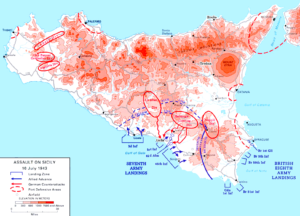
Figure 1: Operation Husky — Allied landings and Axis dispositions, July 10, 1943.
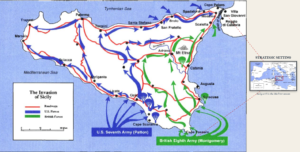
Figure 2: Allied ground advance across Sicily, July 10 July–Aug. 17, 1943.
The pivotal moment for the landings came in the center of the beachhead at Gela. The Axis had spread its mobile reserves to cover the western and eastern sides of the island. On July 10–11, the Hermann Göring Division and the Italian Livorno Division attacked toward the beachhead and nearly reached the sea, threatening to split the American lodgment before it could consolidate. U.S. Adm. Kent Hewitt’s naval gunfire, coordinated with massed field artillery rushed across the beaches and the resistance of the 1st Infantry Division, broke the counterattack and destroyed roughly a third of the German armor in a single engagement. Allied close air support never reached the assault divisions in those first days: Air-ground communication broke down, and the air arm had never integrated its plans. The Army Air Forces’ own official history assessed that air-ground coordination in Sicily was improvised and immature.
Patton’s hasty decision to commit reserve paratroopers over the invasion fleet on the night of July 11 to relieve the crisis at Gela ended in tragedy when Allied gunners shot down 23 transports, inflicting over 300 friendly casualties — one more reminder that joint planning in Sicily was improvised throughout. Despite this tragedy, the Allies stabilized the beachhead and began their hot, hilly, and dusty advance inland.
On July 13, Alexander halted Patton at Highway 124 and gave Montgomery the main roads to Messina — the most controversial operational decision of the campaign. It relegated Seventh Army to flank protection, infuriated the Americans, and bled momentum just as the Axis settled onto the Etna Line. Patton’s response revealed how little even the Allied command controlled its own subordinates: He flew to Alexander’s headquarters, talked his way into a westward drive, and when Alexander tried to rein him back with a new directive, Patton’s chief of staff stalled the message — claiming it had come through garbled — until the advance guard was already in Palermo and the recall was moot. Patton took the city in a four-day sweep, restored American standing, and turned east to race for Messina. The campaign closed not as a coordinated double envelopment but as two armies competing for the same prize.
Beneath the generals’ race was a different campaign. Husky became a brutal infantry grind through Sicily’s spine in 100-degree heat that put men out of the ranks faster than the enemy did — hospital admissions for malaria outran battle casualties, and logistics often failed to reach the fighting soldier. German and Italian defensive positions had to be pried off the heights one by one — above all at Troina, the campaign’s bloodiest fight, where the 1st Infantry Division absorbed 24 counterattacks over six days. The Axis stymied the advance with mines and obstacles on Sicily’s limited mountain roads. Tunisia-bloodied divisions and greener ones such as the 45th applied lessons learned in North Africa by massing combined arms in unforgiving terrain. The 3rd Infantry Division conducted amphibious assaults along the northern coast and rebuilt a blown coastal highway in a single night and day. The 15th Army Group could learn and transmit hard lessons when it chose to, yet could not apply that same discipline to deny the Axis an escape route.
The Axis command had been divided over how to defend the island from the beginning. Once German Gen. Albert Kesselring overrode the Italian plan that counseled concentrating in the southeast, the Germans slowly took control of the combined command. They sent two more divisions to reinforce the island, and when Mussolini’s regime fell on July 25, they dropped even the pretense of a shared command. The German divisions formed the bulk of the defense to delay the Allies. Many Italians, weary of Mussolini’s war, surrendered at the first chance. As German control solidified, the defense became a fighting withdrawal: trading Italian land for time to get their divisions back across the strait. By early August, Gen. Hans-Valentin Hube’s XIV Panzer Corps was running the German withdrawal on its own authority — the unified command the coalition never agreed to, seized rather than granted.
Strategically, Husky delivered. In five weeks, the Allies cleared the island at a cost of roughly 24,000 casualties — 9,500 American, 11,000 British, 2,400 Canadian — and inflicted some 165,000 on the Axis, the great bulk of them Italians taken prisoner as their army dissolved. Mussolini’s regime fell within two weeks of the landings, altering the Axis coalition. It was the first crack in the Axis inner ring and stood as proof that the alliance could fracture from within, not merely be defeated on the battlefield. Italy’s formal armistice in September removed the second-largest Axis power from the war entirely, stripping Germany of both a partner and the Italian forces it had relied on to hold the Balkans and the Mediterranean coast. The Mediterranean opened to Allied shipping for the first time since 1941 and Husky became the indispensable rehearsal for Salerno, Anzio, and ultimately Normandy.
The campaign reverberated across every front at once. Hitler broke off his Kursk offensive — the last great German bid for the initiative on the Eastern Front — partly to free forces for a collapsing south, and the Wehrmacht never again attacked on that scale in the Soviet Union. Italy’s drift toward surrender forced Germany to race to seize Italian weapons and ports before Rome could hand them over to the Allies, then garrison the peninsula and the Balkans with 20-odd divisions it could no longer deploy east. Allied air bases in southern Italy put Romanian oil fields and German war industry within reach of heavy bombers for the first time. Yet the victory was incomplete. Even as Sicily fell, the Wehrmacht was ferrying its divisions across the Strait of Messina to begin a 20-month defense of the Italian peninsula.
Husky’s historiography has long circled the same seductive question the film Patton dramatized: Did letting the Axis escape squander the victory, and should the Allies have gone to Sicily and Italy at all?
Carlo D’Este’s Bitter Victory anchors the command-dysfunction argument, while James Holland’s recent narrative and the British official history counter that clearing a fortified island in five weeks was a genuine achievement and the “too many escaped” critique is overstated. Rick Atkinson’s The Day of Battle offers the dominant synthesis of how poorly coordinated green armies improvised and learned to fight in a trial by fire on the road from Kasserine Pass to Normandy.
Most works also sustain the charge that Sicily needlessly chained the Allies to Italy and delayed Overlord. Douglas Porch’s rebuttal asks the sharper question: If not Italy, where? The operation ultimately knocked Italy out of the war, kept Spain and Turkey neutral, tied down German divisions, and made a premature cross-Channel attack unnecessary.
What both debates share is an Anglocentric frame. What scholarship exists on the Axis side traces its dysfunction to the officer corps rather than Hitler — which only deepens the puzzle of how that command still outperformed the coalition against it.
Military effectiveness is not one thing but a stack of them — tactical, operational, strategic, and political — and competence at one level does not substitute for failure at another. A force can be lethal in the field and incoherent at the echelons that decide campaigns and wars. Husky exposed the shortcomings on both sides. The Allied architecture above the division level struggled to coordinate all its capabilities, focus on the right problems at the correct echelon, and manage too many personal rivalries. The Axis side was worse in many ways, but adjusted its structure to achieve its ultimate endstates of delay and withdrawal.
Unity of Command Cannot be Improvised
American forces have fought joint and combined operations since Yorktown. Better wiring diagrams, clearer authorities, mandated legislation, and more white papers alone do not force commands to function optimally. They cannot manufacture the willingness that structure runs on, and that is the variable Sicily exposes. The Allies had, on paper, already fixed the problem. The command chaos of Kasserine Pass in February 1943 had produced exactly the reform the doctrine prescribes: Eisenhower reorganized the theater under a single ground commander — Alexander — with clear authority over both national armies. Alexander did not lack authority: He held it and declined to use it fully. Coalition command fails not for want of an organizational chart but because allies would rather keep national prerogative than surrender it. The wiring is the easy part: The willingness is what loses campaigns.
The inability of Eisenhower’s headquarters to coordinate joint components throughout is perhaps even more damning than Alexander’s failure. His headquarters held the authority and assets to strike the evacuation at Messina’s docks and ferry crossings and never did.
The Decisive Moment is the Enemy’s Escape, not his Defeat
Over 17 days the Axis ferried more than 100,000 men and 10,000 vehicles across two miles of water to Calabria. Three months earlier at Tunis, the Allies had taken a quarter-million Axis troops prisoner — a disaster on the scale of Stalingrad. Messina was the reverse: the moment a battle of annihilation collapsed into a war of attrition.
The escape was not improvised. Hube and his XIV Panzer Corps had planned a phased withdrawal through successive lines to the strait and executed it methodically. At the crossing itself, German Col. Ernst-Günther Baade fused flak, ferries, and rearguard into a unified command of the strait, the joint control at the decisive point the Allied side never built. Ultra cryptography and aerial reconnaissance gave the Allies insight into the Axis evacuation, including the robust German defenses at the strait. On the night the withdrawal ran at full tilt, hundreds of Allied bombers struck Rome and Turin rather than the ferries. The Allies had not formulated a coordinated plan to prevent the withdrawal. The U.S. Navy’s own official history judged the escape of the three German divisions something that could and should have been prevented.
Any forced entry into a contested theater must plan as hard for denying the enemy’s exit as for securing its own. Joint and combined staffs rarely plan for the mass and commitment an attrition fight demands once that window closes.
Improvisation can Rescue a Campaign, But it is not Architecture
Baade’s command worked — and that is exactly the danger. What saved the Axis at the strait was not a system but a workaround: a capable officer handed sweeping powers because the normal structure could not coordinate the services. It is genuinely impressive, and it is the precise shape of institutional failure. Reliance on a Baade is not an architecture: It is the absence of one, rescued by talent.
This is the lesson most likely to be waved off, because it cuts against something the American military admires about itself. The U.S. force prizes initiative, adaptive leadership, and the gifted improviser — mission command is built on the faith that capable officers will close the seams when it counts. Sometimes they will, as Baade did. That faith can leave a command’s or plan’s seams unaddressed. Overreliance on a transformative technology seduces militaries in the same way. They believe the capability will close the seam and they neglect the architecture to wield it. A cultural strength can license structural neglect.
I wore the patches of the 1st and 3rd Infantry Divisions in the U.S. Army, and it was impossible not to feel Sicily in them. The command problems they confronted in 1943 largely remain in modern coalition warfare — no matter how many sensors, autonomous systems, long-range weapons, and networks exist today. The rigors and requirements of combat have not changed. The soldier still digs the same trenches and suffers the same heat, cold, hunger, disease, and exhaustion — and, as Ernie Pyle saw in the Mediterranean, still has to become “half beast” in order to survive. Just ask a soldier in a Donbas trench.
The Axis lost Sicily but saved its army by concentrating command where the Allies would not. The Allies had mass, surprise, and the enemy’s own messages, and still let an army escape across two miles of water. Whatever the next contested theater, that coalition should not remain solely focused on how to get there.
Steven T. Barry is a retired U.S. Army colonel and combat veteran of Iraq and the author of Battalion Commanders at War: U.S. Army Tactical Leadership in the Mediterranean Theater, 1942–1943 (University Press of Kansas, 2013). He holds a Ph.D. in history from The Ohio State University, taught history at West Point, served as associate professor of strategy at the National War College, and has led more than 130 battlefield staff rides.