Join War on the Rocks and gain access to content trusted by policymakers, military leaders, and strategic thinkers worldwide.

An alliance is only as credible as the runway it can repair under fire.
The Pentagon’s latest National Defense Strategy clarifies American aims in the Indo-Pacific while exposing what those aims demand of frontline allies such as the Philippines. The strategy’s emphasis on a “strong denial defense” shifts the metric of credibility. Though the strategy does not specify the objectives to be denied, its logic implies preventing a rapid Taiwan fait accompli and constraining the People’s Liberation Army’s ability to establish sustained sea and air control inside the chain. Whatever the precise intent, the question is no longer how many forces are forward deployed to signal resolve, but whether the United States and its allies can prevent an adversary from seizing control of critical maritime corridors at the outset of a crisis. When the unclassified strategy declares that allies “must shoulder their fair share,” it signals that tangible hard power, and not rhetorical alignment, now defines the value of what it means to be an American ally.
If the United States is serious about denial strategy along the First Island Chain, credibility will be tested less in Taiwan than in the Philippines — specifically in whether Manila can politically sustain resilient, repairable, and survivable infrastructure under pressure.
That test hinges on investing in resilience over symbolism. Hardened facilities, dispersed logistics, and rapid repair matter more than episodic presence. And those capabilities must be politically sustainable in Manila if deterrence by denial is to endure.
The Philippines as a Litmus Test
The Philippines is a revealing test case for whether denial can function politically as well as operationally. If China can exploit the weakness of the U.S.-Philippine alliance, however, the entire premise of a deterrence-by-denial strategy along the First Island Chain is suspect. In other words, the Pentagon’s main strategy will turn on the interaction of geography, alliance structure, and domestic consent.
Geographically, northern Luzon sits astride sea and air routes linking the Philippine Sea and the northern South China Sea, including the Luzon Strait. Batanes lies roughly 120 miles away from Taiwan but more than 500 miles from Second Thomas Shoal near Palawan. The country’s dispersed terrain supports distributed basing, mobility corridors, deception, and redundancy, which are advantages in an era when fixed infrastructure is vulnerable to missile strikes and cyber or electronic disruption.
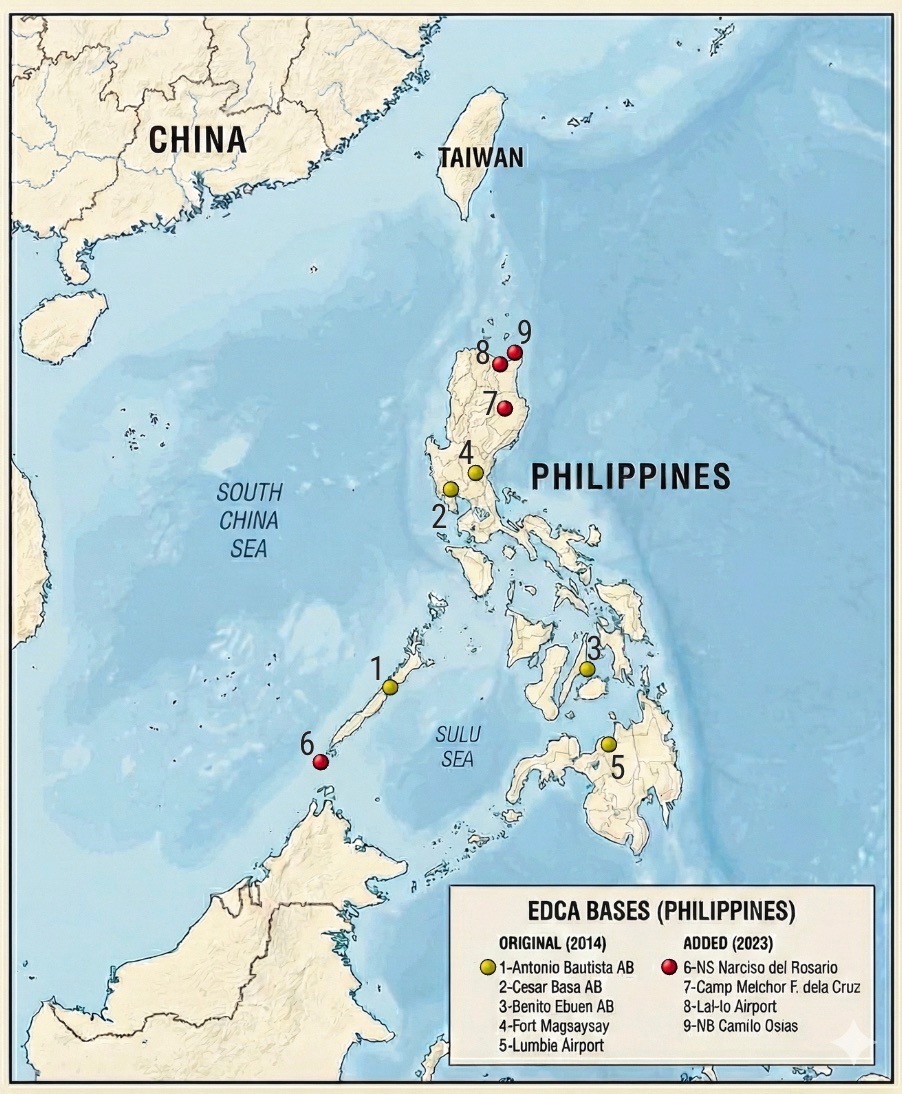
Alliance architecture complicates the sprawling geography. The Philippines is bound to the United States under the 1951 Mutual Defense Treaty, which provides for consultation and a possible combined response to armed attack in the Pacific. After the Philippine Senate rejected renewal of the U.S. bases agreement in 1991, access evolved through the 1998 Visiting Forces Agreement and the 2014 Enhanced Defense Cooperation Agreement. The 2014 defense cooperation framework enables rotational presence, infrastructure development at agreed locations, and prepositioning, all without permanent basing.
The third variable of domestic politics injects extra uncertainty into the alliance’s ability to act in a future crisis. U.S. military presence remains sensitive. A denial posture that cannot withstand democratic debate and leadership transitions is not durable. Former President Rodrigo Duterte’s threat to terminate the bilateral forces agreement underscored that alliance access depends as much on domestic legitimacy not being questioned by the “political pendulum” as on military rationales.
Resilient Access
Denial ultimately depends on whether forces can operate under fire. Functioning well during a period of high disruption or combat puts a premium on resilience. That pushes the 2014 cooperation agreement toward distributed logistics, rapid repair, and redundant communications. Infrastructure and industrial capacity may matter more to deterrence than fleet numbers or episodic presence operations.
The defense agreement’s “places not bases” design supports this organizing principle. It concentrates on infrastructure, access, and prepositioning rather than permanent footprints. Legal durability reinforces continuity of operations. In 2016, the Philippine Supreme Court upheld the 2014 accord’s constitutionality, preserving the framework despite political contestation. Continuity matters because hardened infrastructure, stockpiles, and command networks require sustained investment and erode quickly if reversed by political turnover.
Risk management depends on how alliance commitments are defined and communicated. The Mutual Defense Treaty commits each party to act in accordance with its constitutional processes; it does not mandate automatic combined military action. By anchoring obligations in consultation and constitutional processes, the treaty tempers automaticity, creates shared risk, and leaves space for adversaries to test alliance cohesion.
U.S. declaratory policy has grown more specific in recent years. In 2019, Secretary of State Mike Pompeo proclaimed that “any armed attack” on Philippine forces, aircraft, or public vessels in the South China Sea would trigger U.S. obligations under Article IV of the treaty. Such clarity strengthens deterrence messaging. It may also increase the perceived strategic value of Philippine facilities in a crisis, raising the likelihood of coercive actions short of war.
While more ambitious proposals, such as prepositioning Taiwan-related munitions at U.S. sites in the Philippines or permanently stockpiling munitions for Typhon missile systems, may be politically untenable at present, steady progress in upgrading infrastructure in northern Luzon and Palawan would provide a concrete measure of the alliance’s deterrence credibility.
Philippine official messaging on the 2014 defense cooperation agreement consistently emphasizes sovereignty, the absence of permanent bases, and defensive missions such as humanitarian assistance and disaster response alongside deterrence and interoperability. This framing is essential because domestic consent functions as a Clausewitzian political center of gravity. If alliance defense infrastructure is viewed as enabling offensive operations disconnected from Philippine territorial defense, political resistance can weaken operational credibility.

Capabilities That Shape Credibility
In the Philippine context, denial is built on four elements: maritime sensing, coastal defense, mobility, and repair capacity.
First, maritime domain awareness and fused intelligence, surveillance, and reconnaissance cue both Philippine and allied systems while improving attribution of gray-zone coercion.
Second, mobile, survivable coastal defense capabilities integrated with sensing networks offer greater deterrent value than static and easily targeted platforms.
Third, dispersed logistics determine staying power. Fuel, munitions, spare parts, and runway or port repair under attack conditions define endurance. This operating concept aligns with distributed maritime operations and expeditionary advanced basing concepts that prioritize dispersion and survivability against precision strike.
Fourth, rapid repair and redundancy through hardening, deception, and alternative operating concepts sustain operations even against an anti-access precision strike threat. Alliance-related infrastructure, including storage, redundant communications, and repair capacity, contributes to deterrence only if it remains usable amid hostilities.
Denial along a chain is not a single engagement but a prolonged contest over attrition and sustainment. Maritime sensing enables everything; coastal defense imposes costs; logistics sustain operations; and repair allows for regeneration amid combat.
The Pathway to Philippine-Owned Denial
In a world where runway repair, dispersed logistics, mobile coastal defense, and domestic political durability define strategic relevance more than forward presence, policymakers should carefully consider and manage risk.
An immediate, first risk is that a focus on deterrence at the high-end is an invitation for what Beijing thinks of as peacetime offensive operations. If Philippine territory is seen as critical enabling infrastructure, China may employ cyber operations, sabotage, information campaigns, and other means short of war to raise the political cost of access without triggering military action. After flying a drone over Taiwan’s Pratas Island in January, China could readily extend unmanned surveillance operations across the Bashi Channel to monitor U.S. and Philippine forces. As Indo-Pacific Command chief Adm. Samuel Paparo observed in Honolulu earlier this year, Beijing’s coercion of the Philippines has intensified even as Washington has pursued strategic stability with China. Ramming, blocking, and water-cannon attacks by China’s maritime forces have become routine.
At a moment when the United States expects allies like the Philippines to manage such gray-zone pressure, both Washington and Beijing are normalizing maritime coercion that edges toward gunboat diplomacy. It requires little imagination to see how Chinese officials might probe this dynamic for seams in the U.S.-Philippine alliance.
Probing alliance resolve becomes part of the competition, and the temptation for such coercion may be inherent in Washington’s reorientation of U.S. strategic priorities; the reemphasis on defending the Western Hemisphere and Homeland security may signal to Beijing that Indo-Pacific commitments must compete for strategic attention.
A second risk is entanglement. Even if Manila frames defense cooperation sites and activities as defensive, adversary perceptions may diverge. Ambiguity in contingency signaling can magnify miscalculation.
During the Scarborough Shoal standoff, Manila dispatched the navy vessel BRP Gregorio del Pilar to detain Chinese fishermen, signaling a willingness to escalate and an expectation of alliance backing. Washington, however, emphasized de-escalation and did not clarify whether the Mutual Defense Treaty applied. To Beijing, that divergence suggested an alliance seam, one China exploited to consolidate control without triggering U.S. military intervention.
Prospectively, as the Philippines acquires or even hosts coastal defense missiles, upgrades military bases in northern Luzon, and conducts naval patrols with Japan and others, China may miscalculate if it sees such defense strengthening as active attempts to interfere in a Taiwan contingency.
Legal stability alone does not eliminate vulnerability. Political sustainability requires a clear, sovereignty-centered rationale that resonates domestically.
The most secure path is for the Philippines to own resilience in its segment of the First Island Chain. Manila’s “Comprehensive Archipelagic Defense Concept” provides that foundation: distributed access, hardened and redundant communications, rapid repair, and prepositioning calibrated for both wartime sustainment and non-kinetic contingencies such as disaster response. Institutionalized crisis consultation mechanisms can further reduce misperception and escalation risk.
Such an approach strengthens deterrence by increasing uncertainty for potential aggressors while lowering political costs at home. It aligns with the defense strategy’s emphasis on burden sharing by rooting credibility in Philippine-owned capabilities rather than symbolic access alone.
Geography ensures Philippine relevance. Politics will determine whether that relevance translates into durable deterrence. Denial only works if Manila can politically sustain the infrastructure required to make it credible.
Patrick M. Cronin, Ph.D., is the Asia-Pacific security chair at the Hudson Institute as well as scholar in residence at Carnegie Mellon University’s Institute for Strategy and Technology.
Nathaniel Uy is a graduate student at Rice University and a research intern with the National Security and Defense Program at the Hudson Institute and the Baker Institute’s China Studies Program.
Image: U.S. Army photo by Spc. Taylor Gray, U.S. Army Pacific Public Affairs