Join War on the Rocks and gain access to content trusted by policymakers, military leaders, and strategic thinkers worldwide.

On Apr. 7, 1945, aircraft from the U.S. Navy’s fast carrier task force sank the largest battleship ever built, the Imperial Japanese Navy’s Yamato. Escorted by the light cruiser Yahagi and eight destroyers, Yamato was on its way to Okinawa. It was intended to be a one-way trip: Yamato was expected to beach and use its guns as a coastal battery against the U.S. invasion fleet. Its approach was detected by American submarines and signals intelligence. Eleven U.S. aircraft carriers launched almost 300 aircraft. Over about two hours, Yamato was hit more than 15 times by torpedoes and bombs. When Yamato blew apart, the blast could be seen from 100 miles away.
Designed for a clash of battle lines — opposing battleship formations — that never came, Yamato was the culmination of the battleship concept, combining unprecedented firepower, massive armor, and high speed in a hull displacing 70,000 tons. It was the largest and most heavily armed battleship ever constructed. To Japanese leaders, Yamato was more than a ship. It was a symbol of national power, technological prowess, and imperial ambitions.
That symbolism has returned to American politics. President Donald Trump recently announced plans for a new U.S. Navy battleship, reviving a type of warship the Navy abandoned generations ago. Evaluating that proposal requires separating two distinct questions that Yamato itself embodies: whether the battleship still makes operational sense in modern naval warfare, and whether it retains political and symbolic value even after its military utility has passed.
The answer to the first question is straightforward. The operational concept that once justified battleships has been obsolete for decades, supplanted first by aircraft carriers and now by long-range precision missiles and networked fleets. Building a modern battleship would produce a smaller, less resilient, and less lethal force than existing alternatives. The answer to the second question is more complicated. Battleships have always carried symbolic weight far beyond their combat performance, shaping public perceptions of naval power, national prestige, and global standing.
While battleships no longer belong in the U.S. Navy’s fleet, they still occupy a powerful place in the political imagination. Understanding why the Navy stopped building them and why calls to revive them persist requires examining both the operational logic that doomed the battleship and the symbolic logic that continues to resurrect it.
Battleships: What Are They?
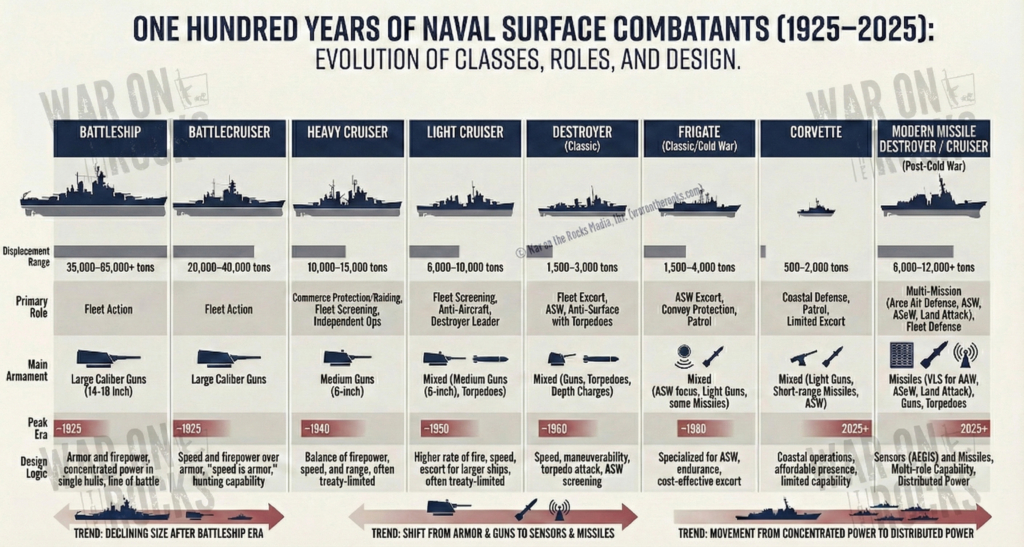
Battleships were the most powerful ships in the world when naval combat was dominated by gunfire. Their origins date back to the ships of the line that ruled the waves in the 17th and 18th centuries. In the 19th century, wooden sailing ships were replaced by steel-hulled, steam-driven warships and the battleship was born. Instead of mounting their guns along the hull in neat rows, like sailing ships, battleships grouped their guns in turrets to provide all-around fire. And such guns! Although the 18-inch guns of Yamato were the largest, ships of the U.S., British, German, Italian, and French navies all mounted guns of 15 inches or larger, firing armor-piercing shells weighing about a ton (the inches here refer to the internal diameter of the gun’s bore).
Those shells were designed to strike other ships and destroy them. During the battleship era, there was a competition between firepower and protection. Initially, battleships were protected by plates of iron and steel. As increasingly powerful guns proved capable of penetrating those plates, rudimentary protection schemes gave way to layered arrangements of face-hardened armor designed to resist penetration and contain the explosion of any shells that made it through. Smaller ships lacked such protection and could not mount guns large enough to penetrate battleship armor. In an encounter between a battleship and a cruiser or a destroyer, the battleship was sure to win. Their size, firepower, and ability to absorb extensive punishment reinforced their symbolic power. They were the largest, strongest, and most survivable ships in the world.
The Battleship Operational Concept
However, because of their reliance on guns battleships always fought at close ranges, at least by modern standards. In 1898, at the Battle of Manila Bay, Commodore George Dewey’s squadron defeated the Spanish from no more than 5000 yards away. Although increasingly accurate fire control systems and new technologies like radar allowed guns to hit at greater ranges in the 20th century, the longest ranges at which battleships scored hits in battle were no more than 26,000 yards, less than 13 nautical miles. For example, HMS Warspite, a British battleship, hit the Italian battleship Giulio Cesare at this distance during the Battle of Calabria in July 1940. The month before, the German battleship Scharnhorst hit the British carrier HMS Glorious at a similar range.
At first, battleships cruised in independent squadrons. However, in the early 20th century, the introduction of new technologies like the torpedo, submarines, and aircraft made it imperative to operate battleships as part of a “balanced” fleet. Cruisers scouted ahead, destroyers screened the battleships and protected them from submarines, and, eventually, aircraft carriers provided an aerial umbrella over the entire fleet. To bring their guns to bear and use them, battleships had to operate in concert with other ship types.
The introduction of carriers changed naval warfare, not because they immediately replaced battleships but because their aircraft could attack at much greater ranges. By the late 1930s, aircraft could strike targets 150 miles away, an order of magnitude farther than battleship guns. That created new opportunities to “attack effectively first,” which, as U.S. Navy Capt. Wayne Hughes noted in his seminal Fleet Tactics, is the most important principle of naval warfare.
At the start of World War II, the striking power of carriers remained limited. Although their aircraft could sink isolated ships afloat or in harbor — Taranto in November 1940, Pearl Harbor in December 1941, and Ceylon in April 1942 were proof enough — a balanced fleet was still necessary to secure command of the sea and undertake major operations. As the capabilities of carriers and their aircraft increased, battleships began to take on secondary roles. The older and slower U.S. Navy battleships, for example, concentrated primarily on shore bombardment for amphibious operations in the latter half of World War II. By the end of the war, it was clear that the validity of the battleship’s original operational concept was coming to an end.
Although the U.S. Navy intended to keep the four ships of the Iowa class — its fastest and newest battleships — in service after the war, the cost was too great and there was no need. Each Iowa required a crew of nearly 2000. With no enemy battleships left to fight — the Cold War Soviet Navy emphasized bombers and submarines — those sailors could serve better elsewhere. By 1950 only one Iowa, the USS Missouri, was still in commission. All returned to service during the Korean War, but they were used for shore bombardment, not fighting other ships. That pattern repeated during the Vietnam War and in the Middle East in the 1980s and 1990s. Although no other ships could match their 16-inch guns, the Iowa-class ships proved costly to refit and operate, and not just in terms of money. Forty-seven sailors died when an error loading the guns caused one of USS Iowa’s turrets to explode in April 1989. All the Iowas were decommissioned by 1993.

Battleships as Symbols
Even as naval warfare changed, battleships remained powerful symbols. In the late 19th century, the number of battleships in a fleet was the standard measure of naval power. Britain asserted mastery of the seas by maintaining a “two power standard.” Formalized in the Naval Defense Act of 1899, it called for the British battlefleet to be at least equal in size to that of the next two largest navies combined. The increasing strength of the German navy in the early 20th century made it impossible for Britain to maintain the standard. Thus, in the years before World War I, Britain and Germany engaged in a building race as the British sought to maintain their lead. While the British and German fleets clashed at the Battle of Jutland in May 1916, the neutral United States committed to build a battlefleet “second to none” to secure its global interests.
To stave off another naval race in the aftermath of World War I, the great powers came together in Washington and signed a series of treaties. The Five-Power Treaty between the United States, Britain, Japan, France, and Italy — commonly known as the Washington Treaty of 1922 — limited naval armaments and used battleships as the gauge. Fixed ratios were set for the size of battle fleets and limits were established for the size of battleships: They could not exceed 35,000 tons or be armed with guns larger than 16 inches. That forced the cancellation of most of the U.S. Navy’s 1916 program as well as similar programs in Britain and Japan.
Exceptions for some existing ships were made. The British were allowed to retain HMS Hood, the largest capital ship in the world. Nominally a battlecruiser (traditionally a battlecruiser combined battleship guns with cruiser armor to secure high speed), HMS Hood was armored on the scale of some battleships. The ship cruised the world in 1923 and 1924, visiting sites in Africa, India, Australia, New Zealand, North America, and the Caribbean. This “Empire Cruise” reminded the world of the power and global reach of the Royal Navy. It was a symbolic blow, then, when German battleship Bismarck sank HMS Hood during the Battle of the Denmark Strait on May 24, 1941.
Seven months later, the U.S. Navy suffered similarly when the Pacific Fleet’s battle line was destroyed at Pearl Harbor. Just a week before the attack, the program for the Army-Navy football game proudly displayed a picture of USS Arizona, with the caption proclaiming that “despite the claims of air enthusiasts no battleship has yet been sunk by bombs.” USS Arizona was sunk on Dec. 7, 1941, consumed in a conflagration triggered by a Japanese bomb. The destruction of the U.S. Navy’s battle line was a symbolic blow as much as a physical one and it disrupted the Navy’s moral cohesion as the Japanese intended.
Yamato was the ultimate expression of this trend, a culmination both of battleship as warship design and battleship as symbol. However, the time and effort devoted to its construction could arguably have been better invested in creating the kind of balanced fleet Imperial Japan needed to win a mid-20th-century naval war. While that might not have prevented defeat in World War II, it would have given the Japanese more options. The symbolic aura associated with Yamato and its twin Musashi meant that the Japanese were hesitant to risk them and they spent most of World War II underutilized.
The Concept Behind USS Defiant
This history is useful for evaluating Trump’s proposed battleship class, dubbed the Trump class. The administration has stated the first of this class will be the USS Defiant. The operational concept behind the design is weak. In a modern fleet, missiles have become the primary weapon. Just as aircraft supplanted battleship guns in the 1940s, missiles have today supplanted aircraft. They can strike farther, faster, and with less risk because there is no aircrew to suffer loss or capture. However, from the specifications that have been shared, the USS Defiant will carry a vertical launch system with just 128 cells and 12 conventional prompt strike missiles on 35,000 tons.
This compares poorly with existing ships in the Navy’s inventory. The latest Arleigh Burke-class destroyers mount 96 cells on 10,000 tons. Since the size of a ship is a reasonable approximation of its cost, three Arleigh Burke ships would provide 125 percent more firepower (288 cells versus 128) for less expense than one of the Trump class. The ships of the Zumwalt class are being refitted to carry 12 conventional prompt strike missiles in addition to 80 cells on 15,000 tons. Comparing them to the USS Defiant leads to a similar outcome. Two Zumwalts give twice the missiles and 25 percent more launch systems (160 vs. 128) at less cost than one of the Trump class.
Building the USS Defiant and additional ships of the Trump class would result in a smaller, less capable fleet. Unlike the battleships of the 20th century, which could endure substantial battle damage and keep fighting because of thick armor and watertight subdivisions, the USS Defiant’s fighting strength will be determined by its vulnerable electronics. That means avoiding hits, not fighting through them. In the missile age, a larger fleet with more ships has a distinct advantage because it presents the enemy with a greater targeting challenge. Today, defense is rooted mainly in numbers and dispersion, not armor. The best approach for the U.S. Navy is to not build the Trump class but larger numbers of smaller ships instead. Not only would that mean more vertical launch cells, and therefore greater firepower. It would also mean a more resilient fleet, with greater capacity to absorb enemy attacks and keep fighting.
This is particularly important given the U.S. Navy’s distributed maritime operations concept, which involves fighting the fleet as a network. The resilience of a network, or, in this case, the survivability of the fleet, increases with the number of nodes. Building the Trump class would mean fewer nodes, decreased resilience, and less overall capability. Jeff Vandenengel articulated this argument well in his book, Questioning the Carrier. Although Vandenengel’s argument centered on the carrier battle group, it can be employed equally well against the new battleship. Both risk investing too much in large, costly platforms that restrict the fleet’s flexibility and fighting power.
The Golden Fleet
However, the fact that it is a large, costly platform is the most valuable thing about the USS Defiant. The president’s announcement has captured the attention of the public and raised questions about U.S. Navy ship design. What he has proposed is not just a new ship, but a symbolic resurrection of U.S. naval power, captured in the idea of a “Golden Fleet.” In that sense, more than any other, the Trump class harkens back to the battleships of old.
I believe that Secretary of the Navy John C. Phelan and Chief of Naval Operations Adm. Daryl Caudle have embraced the battleship idea because they understand this. I hope they also know the operational concept is weak. They probably know Congress may never authorize such a ship. However, they also know that they need to draw attention to the fact that the U.S. Navy needs investment. For decades, it has been asked to do too much with too little, putting undue pressure on ships, officers, and sailors. If Trump’s proposal to reinvigorate battleship construction can raise the visibility of that challenge, increase investment to adequately address it, and lead to a more capable force, then it will be worthwhile. While Congress is set to boost the Navy’s shipbuilding account in the Fiscal Year 2026 budget, I suspect it will not appropriate funds for a new battleship anytime soon. However, the Navy may very well waste research and development funds designing the Trump class — which it can do without congressional approval.
The U.S. Navy doesn’t build battleships anymore because the need for them has passed, but the Navy does need to find ways to capture the imagination of the American people and encourage investment. Battleships remain symbols of national power and prestige. The public’s linkage to them is more tenuous than it was a century ago — most battleships are gone, but the aura and majesty that surrounds them survives. The president and Phelan have tried to tap into that with the USS Defiant.
Trent Hone is the Marine Corps University Foundation chair of strategic studies at Marine Corps University in Quantico, Virginia. He is the author of several books, including Learning War: The Evolution of Fighting Doctrine in the U.S. Navy, 1898–1945 and Mastering the Art of Command: Admiral Chester W. Nimitz and Victory in the Pacific War. He is the co-author of Battle Line: The United States Navy, 1919–1939.
These views in this article do not represent those of the U.S. Marine Corps, the Marine Corps University, or any part of the Department of Defense. The views in this article similarly do not represent those of, the Marine Corps University Foundation.
**Please note, as a matter of house style, War on the Rocks will not use a different name for the U.S. Department of Defense until and unless the name is changed by statute by the U.S. Congress.
Image: U.S. Navy


