Join War on the Rocks and gain access to content trusted by policymakers, military leaders, and strategic thinkers worldwide.

The Battle of Kasserine Pass in February 1943 was the first significant engagement between German and U.S. forces in World War II. The fight delivered a harsh reality check to U.S. military leaders. Early American confidence after Operation Torch collapsed as Axis forces, led by Field Marshal Erwin Rommel, inflicted an embarrassing setback. In multiple engagements in the Atlas Mountains of west-central Tunisia between Feb. 19 and 24, unprepared U.S. forces retreated chaotically. Weaknesses were on display throughout the fighting: Poor logistics, inexperienced troops, piecemeal deployments, and ineffective leadership combined to result in a defeat that shook American morale and dispelled illusions of an easy Allied victory in North Africa. While the battle initially emerged as a story of defeat against a powerful enemy, the Axis failed to capitalize on the early success. In contrast, the Allies adapted and eventually secured North Africa, gaining valuable combat experience before the subsequent phases of the war. Often hailed as an epic failure, the battle was anything but.
The Road to Kasserine
The battle was part of the Allied North African Campaign’s final phase. The campaign was conceived as part of the Allies’ “Germany First” strategy of making the defeat of the Nazis the highest war priority. At the Arcadia Conference in Washington, D.C., in late December 1941 through mid-January 1942, Gen. George C. Marshall advocated for an immediate cross-channel invasion of Western Europe in 1942. Seeing the Allies unpreparedness for such a complex operation, British Prime Minister Winston Churchill and the British leadership favored invading French North Africa first. The idea was to enable Free French forces to cooperate with the Allies after the defeat of 1940 and the emergence of Vichy France, relieve pressure on the British in Egypt, and to show the American public that U.S. forces were taking the fight to the Wehrmacht. At the same time, the Allies could placate Soviet requests to open a second front against the Axis. U.S. President Franklin D. Roosevelt overruled Marshall’s plan and was persuaded by Churchill to prioritize the Mediterranean and North Africa.
After months of preparation, an Allied force, comprising over 80,000 American and 20,000 British troops, launched Operation Torch on Nov. 8, 1942. Lt. Gen. Dwight D. Eisenhower commanded the overall effort, while British Adm. Andrew Cunningham led allied naval operations and Lt. Gen. Kenneth Anderson commanded the British ground forces attached to Eisenhower.
Operation Torch was an incredible logistical undertaking that involved three armadas and an amphibious landing near Casablanca in French Morocco, as well as at Oran and Algiers in French Algeria. At the time, it was the biggest and most complex amphibious operation in world history. The Western Task Force, which arrived in Morocco, had sailed directly from the United States. After seizing key ports, roads, and airfields while facing only limited French resistance, the Allies shifted their focus to the east. On Nov. 23, scores of mechanized units launched the “run for Tunis” — a rapid advance east from Algeria to capture the vital port of Tunis and forestall an Axis military buildup in Tunisia.
Allied forces converged on Axis-held Tunisia, with Gen. Bernard L. Montgomery’s British Eighth Army advancing westward from Egypt while the U.S. II Corps, commanded by Maj. Gen. Lloyd R. Fredendall, pushed eastward from Algeria. The Allies aimed to trap the Axis forces between these fronts. Despite having 32,000 soldiers in the area, the U.S. II Corps was poorly positioned to defend the undulating, mountainous terrain as its commanders had failed to personally reconnoiter the area. Meanwhile, reinforcements across the Tunisian bridgehead swelled the Axis ranks to approximately 100,000 troops. Rommel, who later became popularly known as “the Desert Fox” for his skillful leadership of German and Italian forces in North Africa, sensed an opportunity to exploit the inexperienced Americans. Seeing an American repositioning from Gafsa toward the direction of Gaves as the most dangerous threat to his forces, Rommel planned an offensive against the U.S. II Corps to delay the Allied rendezvous at Tunis.
On the ground in Tunisia, the Allies had their forces arrayed with the British V Corps to the north, Gen. Louis-Marie Koeltz’s XIX Corps, consisting of two newly formed Free French divisions in the center, and Fredendall’s II Corps to the south. The 168th Infantry Regiment, assigned to the 34th Infantry Division within II Corps, serves as one example of a lack of preparation and scattered employment within the American force. They stood isolated on high ground east of the town of Sidi Bou Zid, near Faid Pass, and attached to the 1st Armored Division, which led to some of the command-and-control problems during the battle. The rest of the 34th, who had been one of the first American divisions deployed to Europe, held the northern sector.
The inefficiency of the nascent U.S. Army replacement system was apparent before the battle had even begun. For example, at Sidi Bou Zid, the 168th received 450 new troops just days before the fighting, many of whom had “never been through basic training” and even lacked rifles. On Feb. 12, the regiment got its first shipment of bazookas. Soldiers learned how to use them against some of the first German armor attacks on Feb. 14. Making matters worse, U.S. units were so dispersed across the rolling terrain that commanders sometimes did not know who was under their authority. Units that were split across multiple locations were often reassigned to ad hoc task forces without having clear reporting procedures. For example, Combat Command A of the 1st Armored Division was fragmented across a 30-mile front from Sbeitla to Kasserine, and even as far northwest as Haidra.
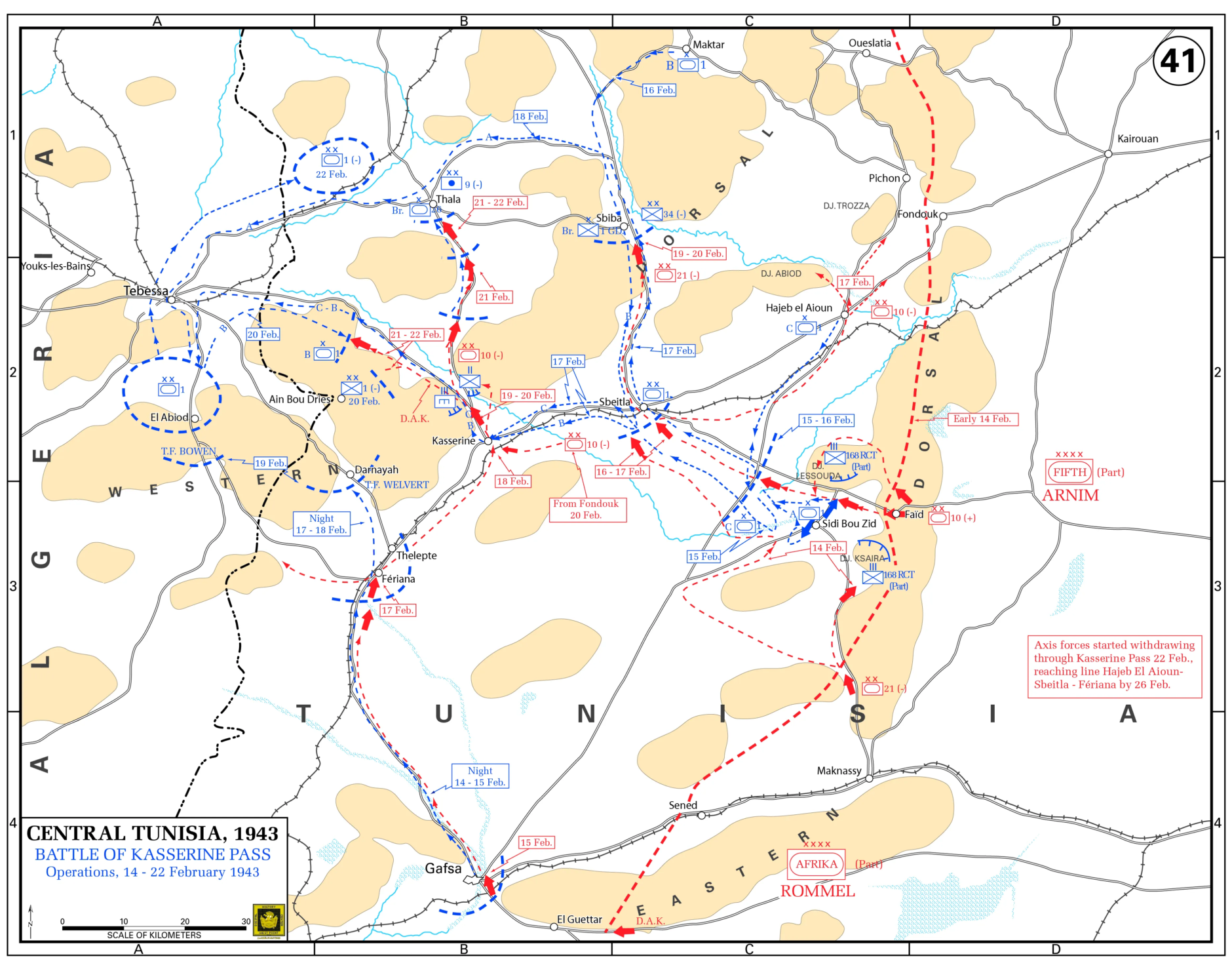
Rommel sensed a chance to seize the town of Tebessa to the west of U.S. positions. On Jan. 30, a kampfgruppe (battlegroup) of the 21st Panzer Division, conducting a reconnaissance in force, struck at approximately 1,500 troops of the French XIX Corps and elements of the U.S. 1st Armored Division in a forward screening position near Faid Pass. After mounting a determined but futile defense, the Allied forces there were forced to retreat. On Feb 14, further west, at Sidi Bou Zid, the 10th and 21st Panzer Divisions engaged the 168th Infantry and Combat Command A from the 1st Armored Division. The German attack succeeded, forcing Fredendall to concentrate his forces at the Kasserine and Sbiba passes to defend critical Allied supply depots.
The Battle Unfolds
Rommel identified an opening to exploit the gap between the British First Army in the north and the American II Corps in the southwest. His plan, called Operation Morgenluft, aimed to seize supply depots and disrupt the growing Allied build-up in North Africa. After initial attacks at Sidi Bou Zid on Feb. 14, German forces launched their main assault into Kasserine Pass on Feb. 19, pushing Allied forces back approximately 50 miles and inflicting casualties upward of 2,500 men. The 1st Armored Division and elements of the 1st Infantry Division withered under the Axis assault, and quickly lost Sbeitla as the Desert Fox outmaneuvered the Americans’ armor and infantry positions.
Axis momentum continued as Rommel pivoted northwest toward the strategically vital Kasserine Pass. A two-mile-wide gap in the Grand Dorsal Chain of the Atlas Mountains, Kasserine lay within the American sector. It offered a key avenue of approach to Tebessa and other Allied supply depots. On Feb. 19, German forces advanced into the pass and overwhelmed the poorly entrenched U.S. positions, forcing a disorderly retreat. Simultaneously, the 21st Panzer Division moved toward the Sbiba Pass — 30 miles northwest of Kasserine Pass — but British forces repulsed the attack with concentrated artillery fire, allowing the Allies to focus their forces to the west. As German forces advanced toward the towns of Thala and Haidra on Feb. 21, they encountered increasingly stiff resistance from regrouped Allied forces, including elements of the British 6th Armoured Division and U.S. artillery battalions from the 9th Infantry Division. After racing some 800 miles in just 4 days, the 9th Infantry Division’s artillery proved critical in halting German momentum through massed fire at Thala. By Feb. 22, U.S. Army Air Force aircraft began attacking German columns and rear areas, while British Royal Air Force elements contributed to blunting the German advance. These late-stage attacks proved crucial in disrupting German resupply and movement, while supporting counterattacks by British and U.S. ground forces at Thala.
Throughout the final days of the battle, from Feb. 21 to 24, U.S. forces regained their footing thanks to concentrated artillery fire. The Axis offensive stalled as the Americans reorganized near Tebessa, stalling the German advance northwest at the towns of Sbiba and Thala, as well as Kasserine Pass. Axis forces continued to probe for weaknesses and commanders considered pressing the attack, but they ultimately failed to exploit their early gains. Facing stretched supply lines, fuel shortages, and mounting Allied resistance, Rommel recognized the offensive had reached its limit and withdrew to the Eastern Dorsal to refocus on defending the Mareth Line and the Axis-held coastal positions of Tunis and Bizerte on Feb. 23. Two days later, the Allies reoccupied Kasserine Pass.
In the end, the toll was heavy. There were approximately 10,000 Allied casualties, including 6,500 Americans, versus only 1,500 Axis casualties. Despite the numerical disparity, the battle ended in an Axis withdrawal and the eventual Allied occupation of Tunis on May 7, 1943.
Spurring Change
The battle of Kasserine Pass showed that the U.S. Army had much to learn about modern maneuver warfare. Before the battle, units had trained in isolation, with minimal exposure to the complexities of combined arms operations. Communications between armor and infantry units were unreliable, and close air support remained inadequate until much later in the war. The U.S. Army began the war with under-armored and outgunned tanks, lacking proven doctrine, while the Army Air Forces — the predecessor to the modern U.S. Air Force — understandably focused on strategic bombing in Europe instead of close air support in North Africa.
Moreover, no single operational plan coordinated British, American, and French forces in battle. British commanders sidelined the input of their American counterparts on account of inexperience in combat. Without unified command, Fredendall reported to Anderson with unclear authority while air units operated under separate chains. Fredendall worsened matters by positioning his headquarters too far from the front. This diffuse command structure resulted in delayed communication and coordination across the Allied force. This allowed Rommel’s centralized command to exploit gaps between national sectors and cause the collapse of U.S. positions at Faid, Sbeitla, and Kasserine as no single Allied commander had the authority or awareness to mount a coordinated defense.
Kasserine also spurred logistical reform within the U.S. Army. Poor local road networks, vehicle shortages, and overextended supply lines contributed to the initial setback. After the battle, the Allies invested in improved transportation infrastructure, forward supply dumps, and increased mobility by providing more than 4,000 additional trucks. Improvements included upgrading and widening roads, repairing and expanding the rail network, using aerial resupply more effectively, and enhancing port operations, all of which contributed to an improved logistical network in North Africa.
Allied air support suffered during the battle due to inadequate coordination between air and ground units, a fragmented command structure that lacked unified tactical control of air units, and inexperience with close air support doctrine. Early in the battle, American aircraft were largely absent, and the Germans enjoyed air superiority. U.S. commanders including Maj. Gen. Carl Spaatz, the Allied Northwest African Air Force commander, and Fredendall, bickered over the role of airpower. Spaatz wanted his forces to attack airfields, tank parks, and convoys in the rear, whereas Fredendall was adamant that the aerial component create an “aerial umbrella” protecting ground troops. Spaatz prevailed, and Kasserine led to the development of Field Manual 100-20, “Command and Employment of Air Power,” known colloquially as the Air Force’s “declaration of independence.” This doctrine emphasized that airpower’s flexibility to operate independently across an entire battlespace was its greatest asset, and that its control should thus be centralized. Rather than maintaining direct aircraft control, ground forces thereafter submitted air support requests through designated air-ground liaison officers, emphasizing rapid response and unified coordination.
Finally, Kasserine illustrated the complexities and perils of coalition warfare, notably the principle of unity of command. The lack of integrated planning, limited trust between national commands, and inconsistent lines of authority made coordinated defensive operations nearly impossible. Fredendall was often scapegoated for poor decision-making and operated under constraints imposed by a fractured Allied command structure, which blurred responsibilities and hindered responsiveness. Following the battle, Eisenhower reorganized Allied command structure under the new 18th Army Group, led by British Gen. Harold Alexander, and appointed Maj. Gen. George S. Patton to lead II Corps. In doing so, Eisenhower unified Allied command in North Africa.

From Defeat to Learning Opportunity
Through the years, the historiographical consensus has reframed the Battle of Kasserine Pass from a mere defeat to an essential learning opportunity for the U.S. Army. In his official history, George F. Howe characterizes the battle as an intense fight in which the untested U.S. II Corps was driven back, noting that inexperience, fragmented disposition of forces, and command and control issues left the Americans vulnerable. Howe, however, does not resort to the language of disaster. By contrast, some observers have cast Kasserine as the U.S. Army’s most humiliating setback of the war, clinging to the drama of retreat and defeat. This interpretation has helped burnish Rommel’s reputation of invincibility in popular imagination.
More recent accounts by Robert Citino, Carlo D’Este, and Rick Atkinson argue that understanding Kasserine as humiliation exaggerates the scale of the initial Allied failures there. Rather, these three historians highlight the stubborn resistance of American infantrymen, the devastating effectiveness of U.S. artillery, and the fact that Axis forces ultimately withdrew from the area. In this telling, Kasserine appears as a “trial by fire” that revealed important shortcomings but also showed resilience and accelerated the U.S. Army’s evolution into a more effective fighting force.
The Lessons of Kasserine Pass
The lessons of Kasserine Pass remain relevant today. The U.S. Army’s Field Manual 3-0, Operations, emphasizes the very principles that were violated in the mountains of Tunisia, namely unity of command, decisive maneuver, and synchronized fires across all domains. In addition, the challenges of multinational interoperability are as apparent today as they were in February 1943 and inform current U.S. Army and joint doctrine. Though operational contexts evolve, and history offers no proper lessons, the battle of reminds us of the importance of five enduring realities about war.
Unity of Command and Integration of Forces
In Tunisia, unity of command among the Allies was nearly nonexistent. Allied force structure resembled a loose coalition characterized by poor synchronization of efforts and national rivalries. Modern doctrine stresses unity of effort across services and domains. Field Manual 3-0 describes how U.S. Army forces should integrate with joint and allied capabilities to avoid the sort of ad hoc, fragmented deployments seen at Kasserine. Like the Iraq and Afghanistan wars, future conflicts involving U.S. forces may involve multinational coalitions requiring interoperable networks and clear command authority among partners.
Realistic Training and Experience
In early 1943, most American servicemembers had never seen combat nor had they trained under conditions that mimicked a live battlefield. At Kasserine, it was evident that the Allied forces were not accustomed to operating as a single, coherent force. More training together at the division and above levels could have alleviated some of the difficulties experienced coordinating adjacent units in the battle. Today’s U.S. Army faces a similar challenge with a lack of experience in large-scale combat operations. Only tough, realistic training can provide the necessary lubricant to alleviate the inevitable friction of combat against a determined foe. Multinational training exercises designed to prepare Americans to fight alongside allies are critical to cultivating interoperability. Practicing integrating forces now will help ensure that the next “first battle” will not be a rude awakening.
Logistics Survivability and Sustainment Under Fire
No matter how advanced battlefield technology becomes, victory depends on the ability to move, supply, and reinforce combat forces. At Kasserine Pass, strained Allied supply lines directly contributed to the struggle early on, while the ability to attack Axis supplies by air contributed to the eventual victory. Today’s Army has internalized this lesson as “contested logistics.” The Army is redesigning its sustainment strategy to focus on dispersion, redundancy, and protection by emphasizing forward tactical stockpiles, mobility, and tactical deception. Prepositioned stocks and strategic reserves are central to this effort. Kasserine’s hard truth still holds: The side that sustains its frontlines while disrupting the enemy’s has the advantage. In large-scale combat, sustainment remains a vital component.
Command Presence
The chaos at Kasserine Pass highlighted how battlefield outcomes often depend on effective leadership. Commanders should be present, informed, and decisive. Fredendall stayed too far from the front, disconnected from reality, and lost the confidence of his subordinates through his absenteeism and micro-managing. Patton replaced him after the battle and made his presence felt immediately, instituting discipline and leading from as close to the front as possible. Physical presence may be less crucial in the digital age, but awareness and trust remain essential. Modern U.S. doctrine embodies this principle in “mission command,” which is meant to decentralize decision making by empowering subordinates. Nonetheless, no technology can replace a forward-thinking leader who sees the battlefield clearly and acts with purpose. Leadership can turn likely collapse into improbable victory.
Adaptability
The final and perhaps most enduring takeaway from Kasserine is the importance of adaptability — not just by individual units or commanders, but as an institutional trait of the Army. Facing the prospect of major war in the future, the United States should institutionalize adaptability before the shooting starts by fostering an organization that learns continuously, anticipates failure, and adjusts rapidly. At Kasserine, rapid adjustment by U.S. units, particularly in the employment of artillery, turned back the Axis attack.
Conclusion
Despite longtime U.S. Army emphasis on “winning the first battle,” the actual test of an army is its resilience and ability to adapt, particularly under fire or “in contact” with the enemy. First battles are seldom decisive. War, by its nature, can lend itself to long-term attritional conflict. While preparing to win the first battle, military leaders and defense officials should prioritize creating flexible, adaptable, and learning organizations with personnel and equipment that can withstand defeat. Rather than letting the initial setback define their effort, the U.S. Army of early 1943 took the necessary measures to learn and adapt. People tend to learn more from failure than success. Current military professionals would do well to remember that.
The U.S. military should therefore take a hard look at itself to ensure that when the subsequent trial by fire comes it will adapt and overcome. For it is not a matter of whether the United States will suffer a battlefield defeat, but when. For today’s military, and especially the U.S. Army, the battle of Kasserine Pass may offer not a warning but a roadmap through a narrow gap.
Robert F. Williams, Ph.D., is a research historian with Army University Press at Fort Leavenworth, Kansas. He earned his Ph.D. from the Ohio State University in 2023 after a career as an infantry noncommissioned officer. He is the author of The Airborne Mafia: The Paratroopers Who Shaped America’s Cold War Army.
Image: Signal Corps Archive via Wikimedia Commons