Join War on the Rocks and gain access to content trusted by policymakers, military leaders, and strategic thinkers worldwide.

Since 2010, the Department of Defense has been stuck grappling with a rising tide of uncertainty, as changing events continually throw carefully laid plans into chaos. Unfortunately for the Pentagon, the source of this uncertainty isn’t China or the Islamic State, but Capitol Hill. The past several years have seen government dominated by a Congress unable or unwilling to pass funding legislation absent some sort of crisis or looming deadline. Congress’s failure to provide predictable spending and planning information has created uncertainty that has put unnecessary strain on the defense industrial base. This failure has stymied competition and innovation by making doing business with the Department of Defense less attractive. It has driven up costs through delayed and disrupted delivery schedules. Finally, Congress’s inability to work through regular legislative procedures and agree to levels of funding through a normal budget and appropriations process led to the implementation of the 2011 Budget Control Act and, eventually, sequestration. In the aftermath of the 2014 elections, leadership in both the House and the Senate seemed committed to restoring “regular order” and working through the normal budget process. However, internal tensions in the Republican caucus in both chambers, combined with a Democratic White House, make it extremely difficult to see how a budget resolution and all twelve appropriations bills will make it through the legislative process and be signed into law.
The broken budget process
Since the passage of the Congressional Budget and Impoundment Control Act of 1974, the general practice has been for Congress to adopt a joint budget resolution that sets the topline for spending and then pass appropriations bills to fund specific agencies (Defense, Interior / Environment, Transportation / Housing and Urban Development, etc.). These bills would then be signed by the president and would set funding for the next fiscal year. While the process has not always worked in exactly this manner, the general structure governs the process and is considered “regular order.” However, since 2010, the gap between this structure and practice has widened considerably due to a combination of divided government and increasing ideological polarization. The below table displays just how much trouble Congress has had in meeting its basic responsibilities to fund the government.
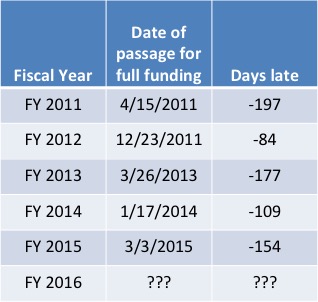
Data from thomas.gov and congress.gov.
However, even this doesn’t adequately capture the full extent of the problems that Congress has had in funding the government. Each of these years has seen the adoption of at least one, or frequently multiple, continuing resolutions. Continuing resolutions (CRs) are short-term appropriations that keep the lights on but fail to provide departments and agencies with the ability to start new programs or redirect money to new priorities. Congress frequently has resorted to CRs to avoid the need to pass more controversial appropriations legislation. However, because these resolutions generally continue funding for existing activities at existing levels, they create major problems for departments seeking to respond to new challenges or move forward with broader plans. As an example, the possibility of a year-long CR in 2013 put the transition of the MV-22 Osprey to a multi-year procurement plan at risk, potentially increasing costs by $1.1 billion for the same number of aircraft.
Beyond the CRs, the failure of Congress to agree to a budget was a contributing factor in the adoption of the 2011 Budget Control Act (BCA), which resulted in sequestration. Concerns over the sustainability of FY 2011 spending levels drove Republicans in the House of Representatives to demand deficit reduction mechanisms in exchange for raising the debt ceiling in August of 2011. The BCA was passed in order to allow for the debt ceiling to be raised, and created a “super committee” (a term all involved likely regret using) to find $2 trillion in deficit reduction by November 2011. When the “super committee” inevitably failed, the BCA imposed a backstop deficit reduction mechanism that sequestered discretionary spending above a topline that guaranteed $1.2 trillion in deficit reduction. Unfortunately, these cuts are imposed across the board, making them highly disruptive and targeting both critical and non-critical programs with similar reductions regardless of department priorities.
Lastly, in 2013, Congress shut the government down in a dispute over funding of the Affordable Care Act. In terms of disrupting planning and budgeting activities, closing the government is one of the single most damaging events possible. The vast majority of Defense Department employees are considered “essential” and required to work during shutdowns, but many civilian employees responsible for support, research & development, and procurement activities were furloughed during the first part of the shutdown. While there has been some brinksmanship around deadlines since 2013, Congress has managed to avoid any gaps in funding. It remains to be seen if this trend will continue in 2015. The past two Congresses have seen major disruptions in their first years (2011 saw a near default on the debt while 2013 featured a government shutdown).
What it means for industry
The combination of budget cuts and erratic budgeting has created significant challenges for industry planning. New contracts don’t move forward, planned cancellations may live on in limbo and costs can be driven up as schedules are stretched to reflect new timelines. Smaller firms that may contribute parts to larger platforms are particularly at risk, as delays in orders might deprive them of necessary revenue to maintain operations. Beyond the damage to the industrial base, these recurring failures impose real, meaningful costs on the government, as per unit costs increase and uncertainty makes reforms and efficiencies difficult to implement. Systems and platforms that might benefit forces in the field take longer to reach the soldiers, sailors and airmen who need them.
According to statistics from a February 28th, 2013 House Armed Services Committee, Subcommittee on Tactical Air and Land Forces, hearing on the Impacts of a Continuing Resolution and Sequestration on Acquisition, Programming, and the Industrial Base, Army procurement programs experienced a 9 percent reduction across the board under sequestration, while the continuing resolution prevented beginning any new programs or planning any multi-year procurement. Similarly, the Navy testified that the sequestration cuts could potentially impact over 100,000 private sector jobs. The Air Force faced delays in starting a number of projects, such as modifications to key platforms (B-2, C-5, F-15). Lt. Gen. Charles Davis and Lt. Gen. Michael Moeller also noted in their testimony the potential damage to the defense industrial base from all this uncertainty, particularly to smaller firms more vulnerable to lost revenue from delays or postponed starts.
These numbers were backed up by reporting from outside sources; the Center for Strategic and International Studies produced a report, “U.S. Department of Defense Contract Spending and the Industrial Base, 2000-2013,” which noted that “Between 2012 and 2013, with the impact of sequestration, defense-funded contract obligations declined by 16 percent to $314 billion.” Further on, the report notes that, “The data show that a disproportionate share of the budget reductions under both the BCA and sequestration has been borne by contracts and by the defense industrial base.”
Where we go from here
Unfortunately, things aren’t likely to get much better. While Congress was able to fund the Department of Defense with appropriations legislation this past December, the budget prognosis for FY 2016 looks significantly worse than FY 2015. The past two appropriations cycles were dictated by the “Murray-Ryan” budget agreement (a two year funding plan negotiated in response to the 2013 government shutdown), but the FY 2016 budgets would see the resumption of sequestration level funding. This would put significant downward pressure on defense spending. However, in response to complaints from defense hawks, the White House and leadership in both the House and the Senate have agreed to bring forward budget resolutions that increase defense spending through the uncapped Overseas Contingency Operations (OCO) fund. They have also indicated an intention to move forward with “regular order” on funding bills. All of this would seem to entail agreeing to a budget and passing individual appropriations bills; however, there are many obstacles to executing such a plan. Defense hawks strongly support increased defense spending both in the base and in the OCO budget. Budget hawks want to see the BCA caps maintained and oppose the attempt to use OCO to increase defense spending. The White House proposed a budget well above the spending caps, and has indicated it would oppose attempts to lift the sequester solely for defense spending. It remains unclear how the Obama administration would react to this proposed OCO plan.
The proposed increase in OCO spending is not without drawbacks. Since the funding is not part of the base budget, multi-year plans or procurement cannot be accounted for. These problems were explained in some detail by the Joint Chiefs of Staff in Congressional testimony last week. “There’s a risk to not funding the base and putting it into OCO,” Gen. Raymond Odierno, Army chief of staff, testified. He warned that the services would need greater flexibility to spend OCO money. Otherwise, current rules are too strict and OCO “might not help us…[A]t the end of the year we [might] have money to give back because we were unable to spend it.” Shifting spending to OCO will make future planning more difficult without actually reducing the deficit, making it unclear what the merits of this approach are outside of placating warring Congressional factions.
Beyond these concerns, it remains unclear if the full House and Senate will agree to these proposed budgets. In the House, budget hawks blocked adoption of leadership’s preferred defense amendment, forcing leadership to use the Rules Committee to attach the amendment on the way to the floor. Similarly, in the Senate, the Chair’s initial mark not only had lower OCO levels, but also included language barring any increase in OCO that was not offset.
Given all of this maneuvering, it is worth having a quick discussion of the math that makes these votes such a challenge. In the House and Senate, Republicans have majorities that allow them to lose 26 and 3 votes, respectively, and still pass legislation. In the House, as demonstrated by the recent funding fight over the Department of Homeland Security, there are at least 52 members willing to buck leadership on critical issues. Many Tea Party Republicans are determined to maintain the spending caps imposed by the BCA, though the number willing to do so at the expense of defense spending is unclear. However, 30 defense hawks on the House Armed Services Committee have issued a call for spending well above the BCA level. It is likely that an adequate number exists on either side to force a Republican budget to require Democratic votes (something they are unlikely to get).
In the Senate, the math is equally muddled. Leadership in the Senate Armed Services Committee has also called for increased defense spending, but it is unclear if the proposed increase will be palatable to budget hawks who could block passage. Even when the budget resolution itself is agreed to by Republicans in both chambers, individual appropriations bills will need to be signed by the president, who has indicated opposition to lifting spending caps solely on defense.
All of this makes it difficult to see how the budget and appropriations process will play out. The dynamics at play in the budget resolution are also at work on individual appropriations bills, in fact they might be even more difficult to agree to depending on the departments and agencies in question. Absent the passage of funding legislation through the normal process, it is likely that, come September, Congress will face another crunch to fund the government by a deadline, resulting in a face-saving scramble for legislation that can pass, rather than legislation that makes sense. Given the current make-up of Congress and the divided structure of government, it is hard to see a scenario in which regular order and normal budgeting are able to proceed. Businesses in the defense industrial base should expect the inconsistent and unpredictable funding process of the past few years to continue at least through the 2016 elections and attempt to plan accordingly.
Matt Vallone is currently the Defense Platforms manager at Avascent Analytics, responsible for maintaining accurate information on ships, aircraft, and ground vehicles for over 50 countries. Prior to this position, he worked as the Legislative Director for Congresswoman Carol Shea-Porter. Avascent Analytics provides data and analysis on trends in budgeting and spending to defense contractors and other companies operating in the government space.
Photo credit: brownpau