Join War on the Rocks and gain access to content trusted by policymakers, military leaders, and strategic thinkers worldwide.

In 79 A.D., Gaius Plinius Secundus, known today as Pliny the Elder, was the supreme commander of the Roman imperial fleet, permanently stationed at Misenum near Naples. He died during the eruption of Vesuvius, after sailing across the bay on a valiant but unsuccessful rescue mission. Amid such heavy responsibilities, Pliny also wrote one of antiquity’s great encyclopedic works. He read and excerpted books of all kinds, and he knew something about Roman monuments. On the form and meaning of the triumphal arch, his explanation was characteristically blunt: “The point of columns with statues on top is to raise a man above other mortals. Monumental arches, a newer invention, mean the same thing.” (Columnarum ratio erat attolli super ceteros mortales, quod et arcus significant novicio invento.)
By Pliny’s day, Rome’s freestanding stone arches were already becoming associated with military victories and the emperors who won them. In the centuries that followed, that association grew stronger. The three best-known surviving arches in the city of Rome today are all within walking distance of one another. The Arch of Titus, erected in 81 A.D., commemorates Rome’s conquest of Jerusalem and destruction of its Jewish temple (the carved menorah is impossible to miss). The Arch of Septimius Severus, erected in 203 A.D., commemorates Severus’ victories over the Parthians from 194 to 195 and 197 to 199. And the Arch of Constantine, dedicated in 315 A.D., commemorates Constantine I’s victory over the rival emperor Maxentius in 312.
In the modern world, these famous examples have helped make the association between monumental arches, military victory, and imperial power especially strong, although — as we will see — the architectural form itself can carry other meanings.
This has always been true. Before Pliny’s time, back in the freer days of the Roman Republic, these monuments had a different name and somewhat wider associations. They were called fornices (vaults or arches), and some were simply magnificent exercises in massive self-advertisement. The historian Livy tells us of one general who returned victorious from Spain in 196 B.C. with an enormous quantity of booty. Without even bothering to seek a triumph, the formal military procession authorized by the Senate, the general simply used some of the spoils to erect three fornices at prominent locations around Rome and topped them with gilded statues.
Strictly speaking, then, his fornices weren’t triumphal arches. They do show, however, that even in republican Rome, a man on the make could use an arch for conspicuous self-advertisement.
The practice of building those fornices was perfectly respectable. The word’s later career was less so. Because prostitutes frequented the vaulted spaces of Roman cities, the word fornix, the singular of fornices, came to mean a brothel. From it developed the verb fornicari, “to visit a brothel,” and eventually fornicatio, and the meaning the word still carries in English today.
It is presumably for this reason that, under Rome’s first emperor Augustus (63 B.C. to 14 A.D.), the Republican fornix gave way to arcus in official usage. The new word meant both “arch” and “bow,” a resonance that scholars have connected with Apollo, whom Augustus presented as his patron deity. (Augustus, too, understood the value of a good brand.)
But Augustus did more than preside over a new name. He also built arches on an unprecedented scale and narrowed their focus. Six arches stood in Rome in 27 B.C., when he took power. By his death in 14 A.D., almost as many new monuments had been added, and Augustus was the patron or honoree of all of them.
This was no accident. Having defeated his rivals in a series of bloody civil wars and secured sole power, Augustus gradually brought triumphal honors under his control. After 19 B.C., Augustus effectively confined full triumphs to members of his own family. Arches increasingly celebrated the emperor and his dynasty exclusively, transforming a relatively flexible form of republican self-advertisement into a monumental expression of imperial power.
That Augustan shift would shape the arch’s reception forever after. Roman arches continued to serve varied purposes, but later European revivals increasingly foregrounded their association with military victory and imperial conquest.
That history brings us to 2026 A.D., the 250th anniversary of the Declaration of Independence. President Donald Trump has decided to build a fornix in Washington, D.C. And it’s a big one. Trump calls it a “Triumphal Arch,” and promises that it will be “more magnificent and larger than the Arc de Triomphe in Paris.”

Why?
To commemorate his victory over Iran, like Septimius Severus? The jury is still out on that.
By his own account, the triumph Trump has in mind is America’s independence, achieved by men nearly two and a half centuries before he returned to office. His fornix, he says, is to commemorate the nation’s founding and its liberation from Britain. To mark the nation’s 250th birthday, it will rise 250 feet, nearly as tall as the U.S. Capitol and half again as tall as Napoleon’s Arc de Triomphe in Paris.
There is nothing inherently strange about marking the American founding with an arch. The problem lies in the particular kind of arch Trump says he wants: a “Triumphal Arch.” It’s a designation he insists on. But calling it a triumphal arch tells almost exactly the wrong story about what the founders thought they had won. The reasons go back a long way.
With the fall of Rome in the West, permanent freestanding triumphal arches largely disappeared as political monuments for centuries. The arch form persisted, especially within churches, while temporary arches remained a feature of royal entries. But the associations were different.
The Eastern Empire was another matter. In Constantinople, the Greek-speaking emperors, whom we call Byzantines though they called themselves “Romans” (Rhōmaioi, the word from which the name Romeo derives), kept Rome’s imperial traditions alive. The city’s Golden Gate was a Roman-style monumental gateway and the ceremonial entrance for victorious emperors. Heraclius entered Constantinople through it after defeating the Persians (the residents of modern-day Iran) in 628. The ensuing celebrations included a parade of four captured elephants before the delighted populace.
Permanent Roman-style triumphal arches returned to the West with the Renaissance fascination with imperial Rome. One of the earliest and most spectacular still stands at Castel Nuovo in Naples, not far from Misenum, where Pliny commanded the imperial fleet centuries earlier. After conquering the city, Alfonso V of Aragon entered it in triumph in 1443. A decade later, work began on the marble arch that now forms the castle’s entrance. Its reliefs show Alfonso’s triumphal entry, while an inscription proclaims him Invictus: unconquered, invincible.
The fashion spread outward from Naples. Western kings, princes, and popes increasingly made ceremonial entries beneath temporary triumphal arches that associated them with Rome’s emperors. Most arches disappeared after the festivities, but one spectacular exception survives on paper. In 1515, the Habsburg emperor Maximilian I (1459 to 1519) commissioned Albrecht Dürer, one of the era’s great artists, to create an enormous printed Triumphal Arch. The result was not a building but a monumental woodcut whose panels turned Maximilian’s ancestry, territories, wars, and imperial ambitions into the visual language of a Roman triumph. Dürer made his entire reign into an arch.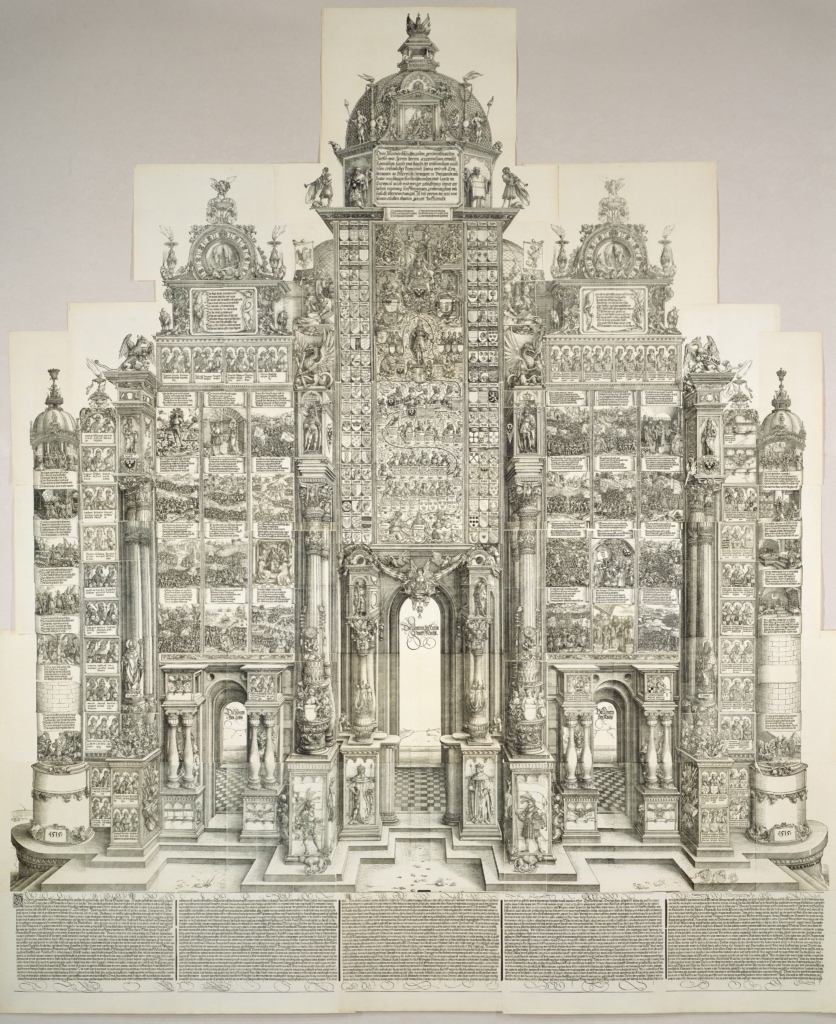
Three centuries later, Napoleon gave Roman triumphalism its grandest modern expression. In 1806, he ordered the Arc de Triomphe to commemorate his victory at Austerlitz. “You will return home through arches of triumph,” he told his soldiers. Its sculptures show French armies marching to war, defeating foreign enemies, and returning victorious. Battle and general names cover its surfaces. The imperial symbolism is unmistakable. It has also proved remarkably durable, turning up in one of the least likely places on earth: North Korea. Kim Il Sung’s enormous Arch of Triumph in Pyongyang, completed for his 70th birthday in 1982, resembles the Arc de Triomphe but deliberately surpasses it in height. It commemorates the official story of Kim Il Sung’s heroic struggle against Japanese rule.
That said, it is important to be clear about what we mean by a triumphal arch. The issue is not simply the arch form itself — the geometry — because if it were, every McDonald’s in the country would be a double monument to victory. In the same way, twisting a piece of metal into a ring does not inherently make it a wedding ring. What qualifies it as one is the purpose, promise, and meaning attached to it.
A stone arch is no different: Its shape alone does not make it triumphal.
The problem lies in the designation, program, and use attached to this particular arch. As I mentioned, Trump insists on calling his fornix a triumphal arch. That characterization inevitably associates it with the arches in Paris and Pyongyang, which celebrate military victory and political authority.
That is why the president’s fornix is so monumentally ill-advised. It mistakes triumphalism for the founders’ own understanding of what the American Revolution and independence meant.
Americans have always borrowed symbols from ancient Rome. George Washington was often compared to Cincinnatus, and even today enormous bronze fasces flank the Speaker’s chair in the House of Representatives.
Americans have had no objection to borrowing Roman architectural forms, either. What they have rarely borrowed, however, is the Roman triumphal program: the monumental celebration of victory over a defeated enemy. The exceptions help us see the rule.
The clearest expression of a triumphal arch in America was New York’s temporary Dewey Arch, modeled on the Arch of Titus and erected for the land parade on Sept. 30, 1899, to celebrate Adm. Dewey’s victory over Spain at Manila Bay. The arch quickly deteriorated, and plans to replace it with a permanent version failed to gain support. New York’s temporary Victory Arch of 1918, modeled on the Arch of Constantine, and Newport News’ Victory Arch of 1919, rebuilt in stone in 1962, belong to the same broad family of victory arches, though both joined victory to the commemoration of returning troops and the war dead.
In Hartford, by contrast, the permanent Soldiers and Sailors Memorial Arch commemorates the service and sacrifice of Union soldiers and sailors rather than their victory. Brooklyn’s Soldiers’ and Sailors’ Memorial Arch is a more complicated case: Inscribed “To the Defenders of the Union, 1861–1865,” the arch’s memorial program also monumentalizes Union victory in the Civil War, as the Arch of Constantine in Rome did.
The pattern is clear: Permanent American arches called “triumphal” usually commemorate a person, a sacrifice, a civic benefaction, or peace rather than monumentalizing victory over a defeated enemy. America likes arches, as people everywhere do, but it puts them to purposes other than the monumental humiliation of a defeated enemy.
The general absence of triumphalism becomes more evident when we consider what this country has never built. Have you ever seen an arch dedicated to the conquest of an Indigenous nation? An Arch of the Sioux Wars, or an Arch of Indian Conquest? Despite the rhetoric, the declaration’s infamous reference to the “merciless Indian Savages” produced no American equivalent of Titus’s monument to the destruction of Jerusalem. Even the soaring arch in St. Louis, which for some represents a legacy of conquest and displacement, frames territorial expansion as a “Gateway to the West” rather than a military triumph over Indigenous peoples. And in any case, it looks nothing like a Roman arch.
Even as the United States expanded through conquest, Americans generally described that expansion in the language of idealism and enlightenment. Trump’s fornix, by contrast, revives a more explicit language of winners and losers, fixing victory and defeat in stone and memorializing former opponents as permanent enemies or, shall we say, arch enemies.
The distinction, then, is not between arches and no arches, but between commemoration and triumphalism.
Distinguishing a wartime opponent from a permanent enemy — and victory from subjection — is not, I hasten to add, some fashionably “woke” presentist idea projected back onto the founders. America’s revolutionary generation insisted on the distinction repeatedly, eloquently, and explicitly. No one said so better than Thomas Paine, the visionary author of Common Sense and so much else. As he insisted at the outset of that revolutionary pamphlet, “the cause of America is in a great measure the cause of all mankind,” not least because America’s cause was not conquest. Conquest was Britain’s aim. It was imperial Britain that was fighting for supremacy, to keep Americans as subjects and compel their obedience. The fledgling United States, by contrast, was fighting for freedom, to cease being subject and govern itself. As Paine put it with extraordinary clarity, “We fight neither for revenge nor conquest.” Indeed, “Our plan is peace for ever.” Independence would allow America to separate from Britain, to make peace with it, come into its own, and engage with other nations thereafter as one sovereign people with another.
The Declaration of Independence says essentially the same thing. Its aspiration was not to reverse the hierarchy between Britain and America but to abolish it, claiming for the new nation a “separate and equal station” among the powers of the earth. Its extraordinary formulation of the desired relationship with Britain was “Enemies in War, in Peace Friends.”
Imagine the opposite. Had Britain won the war, a triumphal arch in London would have made perfect sense. Britain was trying to force its rebellious subjects back into obedience. That is precisely the sort of victory commemorated by Rome’s triumphal arches and, later, Napoleon’s. For the fledgling breakaway republic to reverse that conceit and build such a monument here, much less 250 years after the fact, seems perverse — it’s like celebrating your escape from a bully by posing with your foot on his neck.
Roman precedent points to a way out of Trump’s predicament, however. Not every American arch is triumphal, nor was every Roman one. Many tourists and historians alike use the term triumphal arch loosely, even carelessly. The reality is that many so-called triumphal arches scattered around the former Roman Empire are honorific arches, monumental city gates, or arches commemorating an imperial visit or benefaction. The Arch of Trajan at Ancona, for example, did not celebrate anyone’s defeat. It honored the emperor for improving the city’s harbor at his own expense. Hadrian’s Arch at Athens likewise honored an emperor as a benefactor of the city, not as the conqueror of an enemy. Even the Arch of Germanicus at Saintes, named for one of Rome’s most celebrated generals, commemorated no military victory. Arches like these celebrated new infrastructure projects, imperial benefactions — what we call federal grants today — and the general prosperity of the state.
So here’s the proposal: If program and use determine meaning, change the program.
If Trump is going to have his fornix built in Washington, D.C., there is still time to pivot, to change the sculpture and the story behind it. The president can have his arch without making it triumphal. Call it an honorific arch. Let it celebrate the success of the American project without advertising anyone else’s humiliation. The Romans, after all, provided perfectly good precedents for that too, even in arches conventionally called triumphal. At Benevento, Trajan’s arch commemorates his victory over the Dacians, but it also gives prominence to his civil achievements, depicting him dispensing benefits to Italian children and inaugurating a new highway. Trajan’s arch celebrates public works and generosity rather than enemies crushed beneath Roman feet. That, too, provided a Roman model for commemoration.
Monumental state arches, whether triumphal or honorific, pose another problem, one the Romans themselves noticed: sheer size scale.
In the later first century A.D., the emperor Domitian was particularly fond of arches. According to his biographer Suetonius, he erected tantos ac tot (so many and such enormous ones) throughout Rome, decorating them with chariots and the insignia of triumph, that eventually some anonymous Roman wag got fed up and scrawled a word in Greek on one of them.
What did he write? The single Greek word arkei: “Enough!” Greek speakers who knew Latin could hear the pun on arcus, “arch.” Suetonius thought the joke worth preserving.
Domitian’s critic was not objecting to arches as such, but to tantos ac tot, too many and too big, monumental self-fornication swollen beyond taste into absurdity. Even imperial Rome, in other words, had limits.
One wonders what they would have made of Trump’s 250-foot-tall fornix.
But the arch’s intended use may turn out to be stranger still. Trump now says that, at the “strong request” of the military, his fornix will double as a “Military Complex/Triumphal Arch.” According to our president, it is to house and deploy drones, accommodate snipers on its roof and plaza, and store large quantities of sniper ammunition.
Now, if an arch’s program and use determine its meaning, then a military installation leaves rather less room for ambiguity. So if Trump’s plan comes to fruition, we will have no choice about what to call the thing.
Archie Bunker.
Mike Fontaine is a professor of classics at Cornell University and director of its Program on Freedom and Free Societies. He is the translator of Cicero’s How to Tell a Joke, which explains how politicians can wield humor to win a room, an argument, even an election. His latest book, How to Speak Freely, was published by Princeton University Press on Sept. 29, 2026.
Image: Livioandronico2013 via Wikimedia Commons



,_NGA_76935.jpg)
.jpg)