Join War on the Rocks and gain access to content trusted by policymakers, military leaders, and strategic thinkers worldwide.


On Jan. 7, 2026, President Donald Trump announced:
I have determined that, for the Good of our Country, especially in these very troubled and dangerous times, our Military Budget for the year 2027 should not be $1 Trillion Dollars, but rather $1.5 Trillion Dollars…
While the specifics of the request have not yet been released, a $1.5 trillion defense budget would be a roughly 50 percent increase on the amount requested for Fiscal Year 2026 and an even greater increase above the $839 billion “base” spending levels appropriated through the normal Congressional process. If enacted, this would be the largest increase in defense spending since the Korean War, dwarfing the increases during the War on Terror and President Ronald Reagan’s famed build-up in the 1980s (whose biggest single-year increase was closer to 25 percent).
The recent decision to begin an attack on Iran creates additional complexities for the upcoming budget release. The requirements to replenish munitions and support ongoing operations reflect a different set of priorities than what has been laid out in the National Defense Strategy or in rebuilding the future force. Instead, operations and maintenance spending will suddenly capture a far higher level of spending. As during the Iraq war, modernization needs, unless carefully defended, may fall victim to rising operations and maintenance demands. Given the timing, this will likely require funding as a supplemental addition to FY 2026 spending, though it will undoubtedly have implications on FY 2027 spending.
Defense hawks in Congress are eager to take the president up on this ambitious topline, but actual appropriations, once Congress weighs in, will inevitably reflect legislators’ own priorities and parochial interests rather than the administration’s reform agenda. The central risk to this strategy is that, by setting an aspirational budget figure far beyond what Congress will ultimately appropriate, and indeed beyond the ability of the Pentagon to properly budget for, the White House may lose executive control over the very defense reform and prioritization efforts the increase is meant to support. If the Department of Defense doesn’t make difficult decisions, then Congressional appropriators, not Pentagon leadership, will make the decisive calls about where the money actually goes.
Historical Precedent
In many ways, there are strong parallels to the Reagan administration in the Trump administration’s desire for “peace through strength” and the Reagan administration’s build-up. Commenting on his administration’s defense increases in 1983, Reagan said:
We had to act quickly to increase the basic readiness and staying power of our forces so that they could meet any immediate crisis if one arose. At the same time, we have to make up for lost years of investment by undertaking the research and development and the force modernization needed to meet crises that could arise in the future.
Such language would not be out of place in the Trump administration’s upcoming FY2027 request.
Yet there are myriad differences between the Washington of the 1980s and the Washington of today that make the outcome of a smaller increase in spending far more likely today. Bluntly put: Partisanship is much stronger, the fiscal situation is far worse, and Congress is more dysfunctional. Most of these shifts should introduce skepticism about the ability of Congress to agree to massive increases in defense spending.
Firstly, partisanship. Reagan’s build-up was largely financed by a Democratic Congress (the 1980s being the waning years of the long Democratic House majority). Conservative Democrats frequently sided with the administration, creating an environment where compromises could be had in the appropriations process. Even more importantly, the parties’ cross-cutting ideologies meant that modern parliamentary maneuvers, such as the filibuster, were almost never used. It’s hard to imagine that sort of bipartisan defense build-up in today’s deeply fractured environment.
Similarly, the fiscal situation of the United States has decayed significantly. The Reagan years saw the public debt as a percentage of GDP grow rapidly from just over 30 percent in the first quarter of 1981 to just over 49 percent in the last quarter of 1988. Debt as a percentage of GDP in the first quarter of 2025 was 120 percent. The dollar has spent much of the last year declining in value and the interest rates required to service debt are similarly rising. Reporting indicates that even within the administration, Office of Management and Budget Director Russ Vought objected to the new topline on these grounds.
Lastly, Congress is much more dysfunctional. 2025 saw the longest government shutdown in American history, and it has been well over a decade since annual appropriations bills were completed under regular order. The House of Representatives elected and then removed a speaker, followed by weeks of disorder while a new speaker was elected. While the 1980s witnessed intense budget debates (and Reagan frequently signed appropriations bills in the October through December period), there were no shutdowns remotely comparable to what the past 15 years have seen.
Given all of that, it seems reasonable to be skeptical that the Trump administration will be able to build the coalition it needs to pass a massive increase in defense spending. While Republicans do have unified control of Congress through the end of calendar year 2026, the filibuster precludes a party-line appropriation process, and the narrow margins of control in the House of Representatives make divisions between defense and fiscal hawks all the more difficult to bridge. That’s before noting that appropriations in the modern era almost never finish prior to December or January, meaning a lame duck or possibly even a Congress reflecting potential Democratic wins may ultimately vote on FY2027 funding. Given all of this, it seems likely that even matching Reagan’s performance in getting close to what was requested would be a bridge too far.
Looking at the dollar values in the Reagan requests, Congress never granted the Reagan White House the defense topline it requested during the years of the build-up. Instead, appropriations were only 90 to 96 percent of the requested topline, as seen in the chart below.
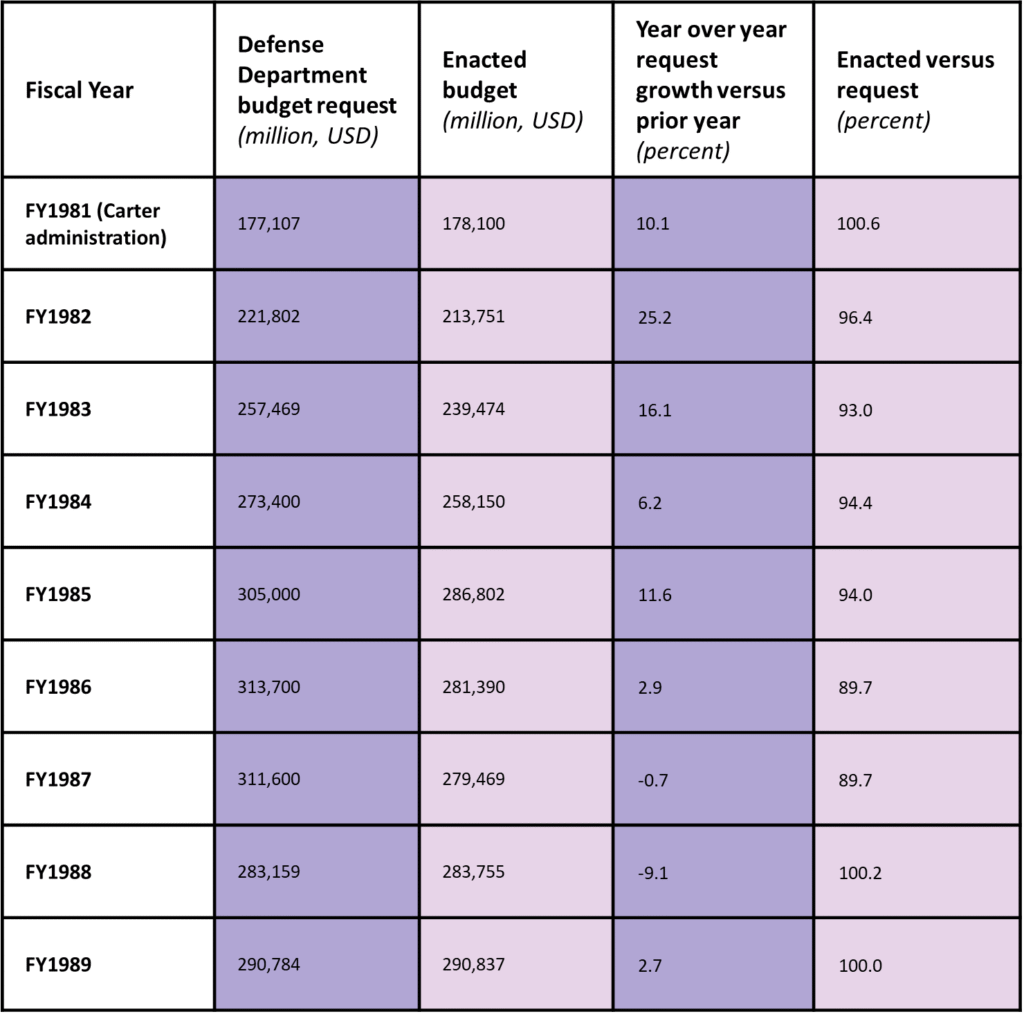
Even 90 percent of a $1.5 trillion request seems unlikely. If you look simply at year-over-year growth, Reagan never got more than a 20 percent increase in spending. Assuming Congress only approves 80 percent of the request, it would be both a massive increase in spending (a roughly $1.2 trillion topline) and also require Congress to find hundreds of billions of dollars in cuts. The table below assumes that the $1.5 trillion figure is for all national defense spending, meaning the Department of Defense’s budget request would be roughly 95 percent of that, or $1.425 trillion.
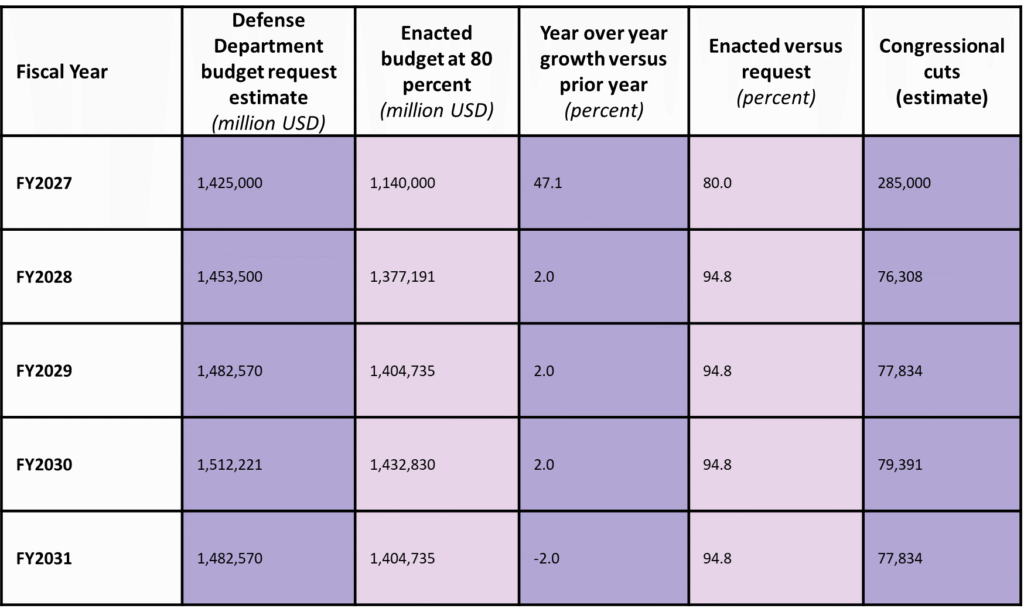
For a sense of comparison, the $285 billion in cuts that Congress would need to find would be equal to roughly 34 percent of the FY2026 defense budget.
The FY2027 defense budget should be the first real opportunity for the administration to propose a financial vision of how its National Security Strategy and National Defense Strategy should be implemented. However, without a clear strategy for getting something close to the requested topline through Congress, the administration risks losing control of spending during the appropriation process.
Higher Spending Comes at More than One Cost
A $1.5 trillion national defense topline seems unprecedented, but when viewed from the perspective of spending as a percentage of GDP, it maps fairly well to historical Cold War spending levels. My current estimate is that such a request would equate to roughly 6 percent of GDP. An elevated level, to be sure, but not outside the outer bounds of Cold War spending. While there are many reasons not to consider spending as a share of GDP as an effective assessment of defense activity, it is at least a useful framework for putting a large number in a more meaningful context. From 1948 to 1990, spending on defense by the United States averaged 4.8 percent. While a $1.5 trillion defense budget would be significantly above the average, it would not be out of place relative to the Reagan build-up or earlier periods of spending.
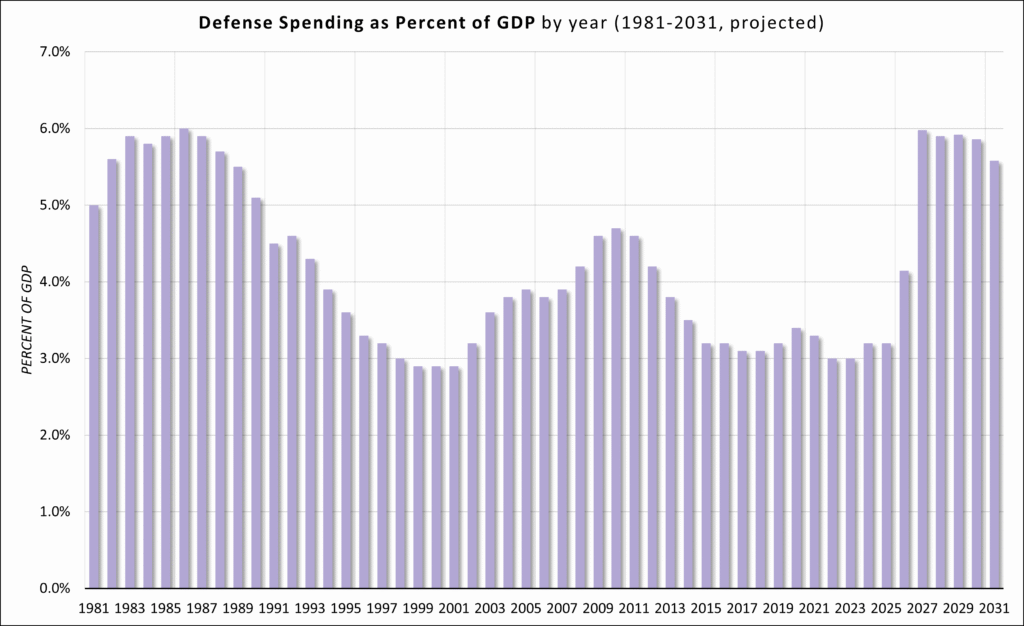
On the face of it, this would seem to be a great outcome for the Department of Defense and the defense industry — record-setting funding increases should allow the expansion of the industrial base, cover program growth in existing programs, pay for the operations against Iran, and potentially catch up on maintenance and sustainment. However, the gap between the administration’s request and what Congress appropriates is likely to be wide, forcing Congress, rather than the Pentagon, to set priorities and make hard decisions. By shifting responsibility from the Pentagon to Congress, the Department of Defense risks losing its ability to drive an appropriations process that funds its priorities rather than the more parochial needs of Congress.
Now, it may be that this is an acceptable trade-off for the administration: accept less control of program specifics in exchange for a defense topline at a level of spending hundreds of billions of dollars higher than FY2025 levels. However, it is entirely possible that this request could result in only a 10 to 15 percent increase in spending (if you include reconciliation, FY2026 only saw a roughly 16 percent increase) while, at the same time, shifting investment decisions away from the Pentagon and towards Capitol Hill. This scenario poses real risks for new starts and the types of innovative programs developing in the growing defense technology base. In previous years, the services have submitted unfunded priority lists worth tens of billions of dollars. In a topline that only grows by $100 billion, those legacy programs, which benefit from strong constituent support, could easily eat up a significant piece of the overall increase.
In addition, one other risk is that a high budget number followed by much lower appropriations can impact the capital flow into the sector. Investment decisions made driven by a budget document that is immediately significantly slashed may have a chilling effect on what has been a robust investment environment for new defense technologies. Following sequestration in 2013, a sharp drop in contracting relative to expectations led to deep uncertainty and investors pulling back. Small businesses that staff up under the impression that they are in the budgetary program of record, only to see their line item slashed to sustainment levels, will face difficulties paying bills and justifying future rounds of investment.
A New National Defense Strategy and Priorities Meet an Old Congress
It would be reasonable to expect that the FY2027 request will put significant funding into the priority areas and would seek to make these programs as accessible as possible to non-traditional defense providers. Whether that means new technology firms providing innovative command, control, communications, computers, intelligence, surveillance, and reconnaissance solutions or expanding the industrial base supporting air and missile defense spending through the Golden Dome program, the budget will make these programs a focus. The Navy’s “Golden Fleet” and Trump-class battleship will also be important parts of the FY2027 increase, though how that investment is divided between traditional firms and new entrants such as Saronic remains unclear.
However, submitting a request that will likely be subject to such significant cuts will play to the advantage of traditional defense suppliers. In what will almost certainly be epic lobbying battles across the FY2027 National Defense Authorization Act and the defense appropriations bill, programs that have hot production lines, employees who are actual constituents, and established Congressional relationships will be much better positioned. Similarly, given the reporting around the Pentagon’s inability to even appropriately budget for the new topline, it is unclear how effective its own advocacy will be. Defense lobbying spending already set records in 2025. This year will almost certainly see much greater spending. New startups and novel solutions would be back-footed relative to incumbents as they lack the on-the-ground support of existing, rather than potential, workforces. As always, the final say will be with the appropriations committees.
The scale of the cuts would force hard changes even within a topline that grows aggressively. Existing programs could soak up much of a 10–20 percent increase. When you then factor in the costs being incurred through Operation Epic Fury, even more of the topline disappears. Even for those programs that Congress funds, it is entirely possible that they’ll be funded at a fraction of the level of the request, creating timing issues for contractors and weakening the programs’ postures in future appropriations.
The Path Forward
This has both short and long-term implications. In the short-term, the Department may be able to patch over some of these cuts through shifting around the remaining reconciliation money from last year’s “One Big Beautiful Bill”. However, smaller and newer entities that are dependent on fundraising may still face a challenging period where investors hold back due to uncertainty over what will survive the Congressional gauntlet. The worst outcome would be that these firms expand capacity and take on costs based on winning work in the request but are denied expected funding during the appropriations process. This would create major headwinds for new entrants.
In the long-term, the more money gets redirected to existing solutions and legacy providers, the more locked in future spending becomes. It is historically rare to see sustained, rapid increases in defense spending. Reagan managed to get fairly significant increases through during his first term, but that was followed by slowing growth and then both real and nominal reductions in his second. By missing out on enriching the industrial base and funding new priorities in the second year of this term, the Department narrows its potential window for truly transformational investments.
A less risky approach would be to present a budget with a major increase but not a shocking one. In many ways, last year’s request with its $1 trillion topline, presents a better path forward. The Trump administration leaned into the existing debates among Congressional Republicans on a reconciliation bill by assuming $113 billion in defense spending for FY2026. This aligned well with what was being considered on the Hill (and in fact was conservative relative to the $152 billion that was eventually enacted). This meant that defense spending for FY2026, based on the current appropriations bills and the Pentagon’s expected portion of reconciliation spending, grew by almost 15 percent.
If the administration had requested another 15–20 percent increase, it still would have faced an uphill battle (Congressional Republicans have discussed another reconciliation bill, but it seems unlikely in an election year), but it would represent a continuation of this year’s success rather than a dramatic challenge. Appropriators, rather than the Department of Defense, will decide how to allocate the toplines that Congress can approve, and the programs that the Pentagon wants but that lack constituencies will be on the chopping block.
None of this is to say that a $1.2 trillion defense budget is a terrible outcome for the Department of Defense or the defense industrial base. It is more a word of warning that an eye-popping presidential request risks creating expectations that Congress will not deliver on, creating problems for small firms and investors alike, whose offerings may not make it through a modern-day Gucci Gulch. Promoters of defense reforms and new priorities are going to need to be proactive in securing Congressional support for their priorities, even in the face of extensive cuts. Failing to do so would undercut the administration’s industrial base agenda, entrench existing programs, and leave the Pentagon with more money — but less control over how it is spent.
Matt Vallone is director of market intelligence at Renaissance Strategic Advisors, a leading specialist in aerospace, defense, and government sector strategy consulting and mergers and acquisitions advisory. In the past, he worked at Next Frontier Intelligence, Avascent, and Janes. Vallone has worked in the U.S. House and Senate and served as the legislative director for Rep. Carol Shea-Porter.
**Please note, as a matter of house style, War on the Rocks will not use a different name for the U.S. Department of Defense until and unless the name is changed by statute by the U.S. Congress.
Image: Petty Officer 1st Class Alexander Kubitza via DVIDS.