Join War on the Rocks and gain access to content trusted by policymakers, military leaders, and strategic thinkers worldwide.


America’s greatest national security threat is an enemy born from and nurtured by the Pentagon: crippling bureaucracy. It starves the oxygen from good ideas, good people, and good technologies while creating ideal conditions for mediocrity to thrive. It has permeated every corner of the system, including the defense-sponsored innovation initiatives — like the Small Business Innovation Research Program — that purportedly exist as its counter.
In 1982, President Ronald Reagan signed the Small Business Innovation Development Act, creating the Small Business Innovation Research program. Its stated objectives include providing American small businesses with non-dilutive funding for research and development in areas critical to national interests and enabling these small firms to transition their technologies to government end-users thereafter. More than four decades and $68 billion later, a program intended to seed commercial innovation instead functions as a taxpayer-funded subsidy for entrenched players, including a handful of ostensibly large firms known as “SBIR mills.”
Mills have won hundreds of Phase I and Phase II awards courtesy of flawed size standards, bureaucratic wherewithal, and misaligned program incentives. By optimizing their businesses to capture maximum program funding, they make it nearly impossible for truly small firms to compete.
After operating unchecked for decades, mills now rest at the center of the debate regarding the future of the Small Business Innovation Research program, which lapsed on Sept. 30, 2025. We began independently analyzing the program using large-scale, publicly available data in 2018, publishing our reports via the Naval Postgraduate School. Our analyses have informed Congressional and Senate testimonies; the 2019 National Defense Authorization Act; and, most recently, Sen. Joni Ernst’s proposed program reauthorization, the INNOVATE Act. We, like Sen. Ernst, recognize that reorienting the program towards its stated objectives requires common-sense size standards, imposing a cap on participants’ lifetime Phase I and Phase II funding, and setting aside a share of Phase I awards for new entrants.
While our data-driven analyses remain wholly independent, our conclusions do draw from our firsthand experience working with federal and commercial clients involved in research and development programs, and as recipients of one defense-sponsored Phase I award and two defense-sponsored Phase II awards between 2019 and 2022. So, to be sure, I am not a neutral outsider. However, it means I have personally endured the challenges facing truly small firms attempting to break into the program, and I have a professional stake in how this program operates. I have been bullied, name-called, and worse — all for circulating transparent data about a taxpayer-funded program. My interest in this work is driven by a belief that the program can and should serve the U.S. national interest more effectively, not by any desire to preserve the status quo for its financial benefits.
How Does it Work? What Are the Phases?
A brief explanation of the Small Business Innovation Research program is necessary here: One of the primary objectives of the program is to help small companies turn early ideas into useful technology for government customers. It does so via sequenced funding opportunities known as “Phase I” and “Phase II.”
In Phase I, companies submit a short proposal that describes a technical concept and how it solves a government-defined problem. If selected, they receive a small amount of funding — typically between $40,000 and $150,000 — to establish the technical merit, feasibility, and commercial potential of their project. The purpose of Phase I is to reduce uncertainty before the government invests significant resources, which occurs in Phase II.
Not every Phase I progresses to the second phase. For those that do, the company receives more substantial funding to build and test a full prototype, gather performance data, and advance towards a capability suitable for government acquisition.
On paper, these steps form a simple pipeline. A small company proposes an idea. The government pays for early proof. If the idea seems promising, the government funds more detailed development. In practice, this pipeline breaks down. Many small companies never make it into the program. Others languish at the end of Phase II with no path for real adoption. Meanwhile, mills receive a disproportionate share of funding yet are incentivized to stay within the small business threshold to pursue more Phase I/Phase II awards, rather than grow and compete for traditional procurement contracts. The resulting system exhausts large sums of taxpayer money without reliably moving new technology into the hands of users, while ingratiating a handful of firms.
Small by What Standards?
Based on data from the Federal Procurement Data System, we found that from Fiscal Years 2005 to 2024, the Defense Department awarded $27.5 billion in Phase I and Phase II funding to 8,945 unique companies. As shown in Figure 1, more than $4.1 billion of it — 15 percent of all Defense Department Phase I and Phase II funding — went to just 25 mills. The top five mills alone captured 5 percent of the entire Defense Department Small Business Innovation Research program budget.
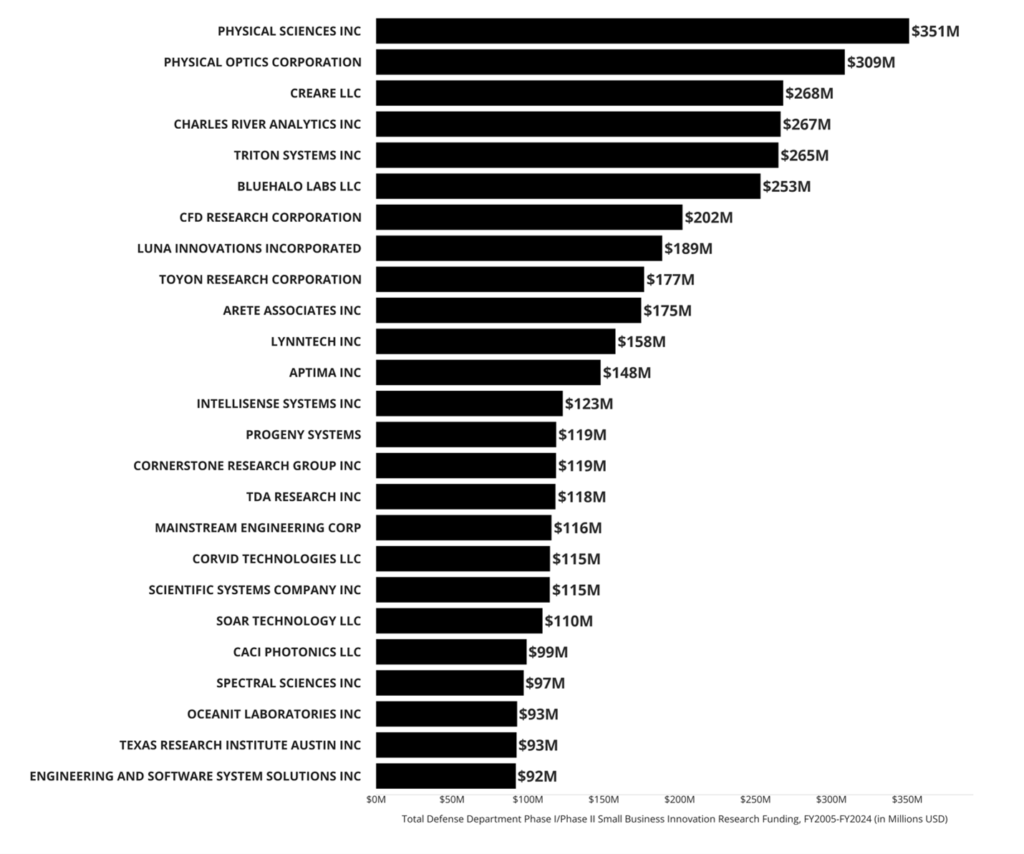
Many mills win program funding from non-defense agencies and generate substantial commercial revenue. Some are even publicly traded. While in name the program is earmarked for small businesses, most reasonable Americans would not consider firms worth hundreds of millions to be “small.” Mills remain eligible because the Small Business Administration permits certain companies to qualify as “small” if they employ fewer than 500 people, irrespective of revenue.
Consolidation at the Expense of Innovation
Furthermore, over the last 20-plus years, commercial companies outside of the government’s traditional suppliers (“nontraditional companies” or “nontraditionals”) increasingly drive technological advancements in areas critical to national interests. Based on its stated mission, the program should serve as an on-ramp for these nontraditional companies to break into the federal market. Yet these flawed size standards have permitted large corporations to capture billions in program funding at the expense of truly small, nontraditional firms.
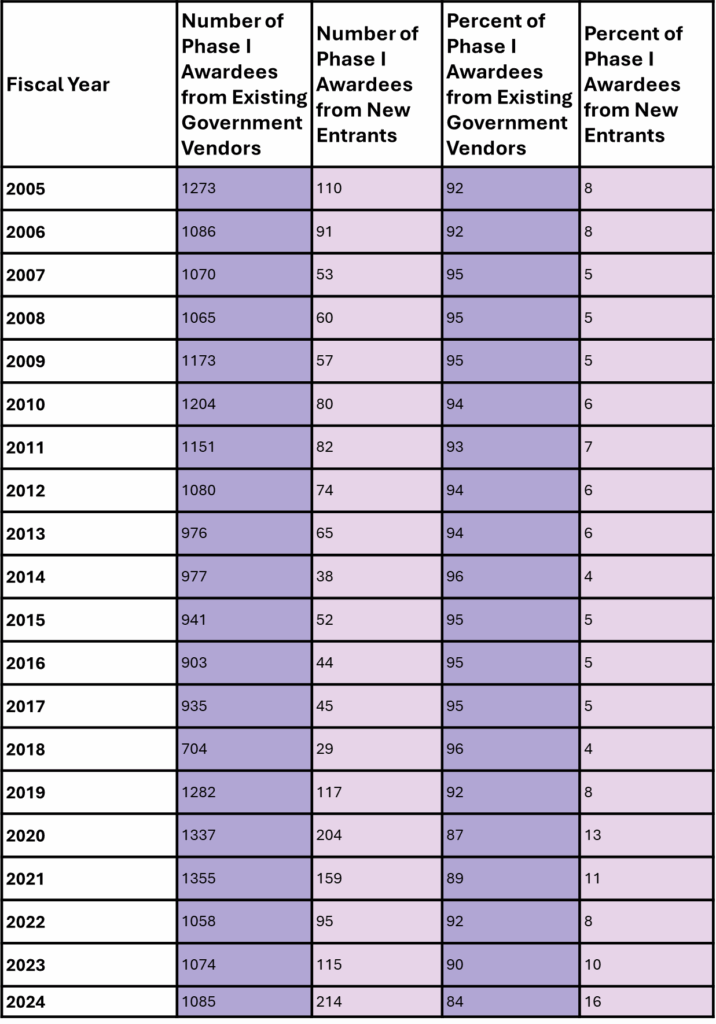
Beyond the largest recipients of program funding, most program participants, in general, are entrenched government contractors, as shown in Figure 2. Using data from the Federal Procurement Data System and USASpending.gov, we found that of the $4.8 billion in Phase I funding awarded by the Defense Department over the last 20 years, less than 4 percent went to companies with no prior federal experience. Rather than serving as a point of entry for innovative new companies into the public sector, the program is corporate welfare for incumbents.
Reorienting the Small Business Innovation Research Portfolio
To the extent Small Business Innovation Research funding is intended for small businesses, qualifying firms should generate less than $40 million in annual revenue. To further curtail cycles of dependency and broaden the pool of participants, Small Business Innovation Research should also cap lifetime Phase I and Phase II funding at $75 million per firm and reserve a set portion of Phase I funding for companies new to the federal market.
These changes would end the era of the mill. Mills, their lobbyists, and the elected officials in states where they domicile, argue that this outcome would undermine a merit-based system. The data suggests otherwise.
The fact that so few new entrants break into the program exposes the merit-based fallacy. Furthermore, mills have no real technological expertise. The award database on SBIR.gov reveals mills winning funding for dozens, even hundreds, of disparate topics. Charles River Analytics, for example, received Phase I and Phase II funding for everything from data analytics for ship maintenance and wearable sensors for Navy divers, to “smart fabrics” and robotic caregiver algorithms. Physical Optics has won awards for missile coatings, cyber tools, unmanned refueling technologies, and more. Physical Sciences’ projects range from atmospheric water extraction to additive manufacturing to hyperspectral imaging. It is difficult to understand how any company, least of all a small business, can be at the forefront of innovation in dozens of fields.
An Inhospitable Ecosystem for Truly Small Firms
Mills dominate the program because it is a bureaucratic literacy test impossible for the uninitiated to pass. Funding opportunities are not marketed to nontraditional companies, the solicitation website is archaic, and requirements are dense, contradictory, and not written in plain English.
Many small, innovative companies forgo the program entirely. Others hire “advisory firms” that, for an upfront fee and a cut of award funding, manage the process. Rather than stimulating innovation, the program taxes it.
Compounding these issues? Small Business Innovation Research program offices are primarily held accountable for administering program funding to eligible firms and for ensuring participants deliver compliant milestones. Despite the mission of the program, they are neither incentivized nor required to take risks. It is no surprise, then, that they disproportionately favor mills.
One separated airman, Michael Meyer, recounted a telling story: While serving as chief of the Air Force Digital Integration Office, he was involved in Phase I/Phase II proposal evaluations. Frequently, he and his colleagues would receive submissions from mills citing the work of truly small, innovative companies to validate their technical approach. Those same small companies would submit proposals for the same topics. Although the small companies possessed a clear technical advantage, the evaluators typically selected the mills. They felt more comfortable awarding to familiar entities, justifying the decision based on the quality of the mills’ proposals. This phenomenon occurs at scale, making it nearly impossible for truly innovative companies to break into the program and creating a system antithetical to merit.
The Valley of Death: Neither Here nor There
Since beginning our research into the Small Business Innovation Research program in 2018, we have argued that its primary objective should be facilitating the rapid integration of cutting-edge technologies force-wide. However, that goal is meaningless when innovative startups cannot access the program, while entrenched companies, including large corporations, capture billions in funding unchecked. Until the program is restructured to value technical merit over bureaucratic fluency, efforts to bridge the “valley of death” are misplaced.
That said, we have produced multiple data-driven reports that find no consistent relationship between a company’s total Phase I and Phase II funding and the extent to which it delivered capabilities to the warfighter.
Both we and the Government Accountability Office have argued that some mills transition at a lower–than-average rate compared to companies with far fewer awards. Figure 3 highlights 15 companies with 12 or fewer Phase I and Phase II contracts that generated more in subsequent non-Small Business Innovation Research procurement contracts (“transition funding”) than many of the largest mills; and significantly more of these “real” government contracts than their attributable non-dilutive research and development awards. These are the success stories (See Figure 3).
Then there are the mills: By comparison, based on publicly-available data, between FY2005 and FY2024, Lynntech won $158 million in Defense Department-funded Phase I and Phase II awards, and only $17.3 million in subsequent non-program contracts; Spectral Energies won $97 million in defense-funded Phase I and Phase II awards and $1.2 million in subsequent non-program contracts; and Scientific Systems won $115 million in defense-funded Phase I and Phase II awards, and only $4.1 million in subsequent non-program contracts. The program continues rewarding these mills, despite their poor post-award performance.

Small Business Innovation Research program offices are not required to track their companies’ post-award performance, let alone factor companies’ historic transition rates into future award decisions. The resulting system incentivizes mills to pursue more Phase I/Phase II funds, rather than comparatively difficult-to-capture non-program contracts. Consequently, their very presence in the program guarantees the existence of a “valley of death.”
Some mills do generate significant non-program procurement, but that is irrelevant. Mills should be excluded from the program based on their size, irrespective of transition rate or any other performance metric. Claiming that they should qualify for the Small Business Innovation Research program because of their ability to transition technologies is akin to arguing that a professional baseball player should be permitted to play on a little league team, since the team wins more games with him on the roster. The issue is one of fairness.
Furthermore, excluding mills from the program does not bar them from the federal market. If their technologies are truly vital, they can compete for the hundreds of billions in non-program government funding available each year.
Conclusion and Recommendations
The capture of the program by mills is a betrayal of the program’s mission and a disservice to national security. While promising startups die in the weeds of compliance, mills thrive courtesy of institutional knowledge and influence. The program should enforce a size standard of $40 million in annual revenue, cap lifetime Phase I and Phase II funding at $75 million, and set aside a share of Phase I funding for companies with no prior government business. These changes would prevent companies from living off these awards, thereby making room for new entrants and creating an impetus for participants to focus on commercialization.
Reforming the Small Business Innovation Research program is not just a duty to the taxpayer. The program holds enormous potential as a catalyst for economic growth and innovation, and it should be rebuilt with these priorities in mind.
Amanda Bresler serves as president of PW Communications, Inc. She runs SHELDON, a subsidiary of PW Communications that provides custom analytics products to federal and commercial clients. Prior to joining PW Communications, she worked as chief operating officer for Maurice Cooper Brands. She serves on the board of directors of PW Communications; St. Dalfour SAS, a French food company; and Chatham International Inc. She graduated cum laude from Georgetown University’s McDonough School of Business.
Image: Anne Neumann via Department of Defense Office for Small Business Innovation.