Join War on the Rocks and gain access to content trusted by policymakers, military leaders, and strategic thinkers worldwide.


At a certain point in software development, patches, fixes, and repairs hit a point of diminishing returns. The system becomes so saturated with technical debt that it barely functions. While many engineers will suggest “one more patch and it’ll run for a few more years,” disciplined and experienced builders know when to scrap the thing and start over from the ground up. This “harder right” option rebuilds the system to meet current demands rather than choosing the “easy wrong” of keeping the old thing running a little longer.
The Small Business Innovation Research program is just such a thing. It’s time to take out a clean sheet of paper and design anew. If Congress and the Department of Defense burn down the decades-old requirements process but leave the current Small Business Innovation Research program and its innovation ecosystem intact, then they aren’t serious about acquisition reform. We propose a program built around a dedicated, flexible transition fund within every acquisition program to pull technologies across the valley of death. We also call for merging fragmented innovation offices, automating topic selection, and replacing disconnected bridge funds with accountable pathways that deliver real capabilities to end users.
To be sure, as the owners of two small defense businesses, we have a stake in this debate, but as military veterans and longtime acquisition professionals, we also see how the current system fails the government, the warfighter, and the mission.
The Broken Process
Congress established the research and development program as a government-wide initiative in 1982 through the Small Business Innovation Development Act. Its core objective has always aimed to stimulate technological innovation, meet federal research and development needs, foster participation by socially and economically disadvantaged small businesses, and increase private-sector commercialization of innovations derived from federal research and development. Despite this noble intent and four decades of history, numerous structural flaws severely hinder the program and create significant shortfalls that harm the entire defense industry, the broader research and development ecosystem, program offices, and end users.
Key problems include a lack of program manager engagement and a “valley of death” (see Image 1) funding gap that stalls promising technologies before they transition from research to acquisition. Acquisition program managers are incentivized to manage cost, schedule, and performance of their current programs and have no incentive, time, or attention span for the research and development sideshow. Furthermore, programs of record lack budgets to utilize these technologies, creating the “valley of death”.
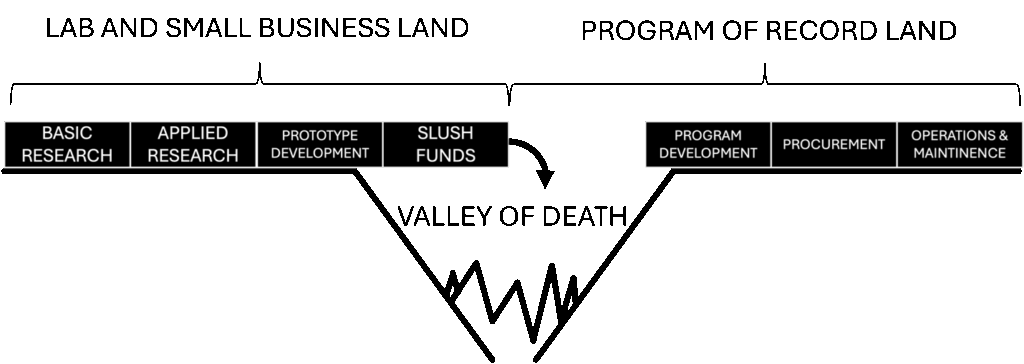
Image 1: The Valley of Death
The program also suffers from inadequately trained technical points of contact, the government program or subject matter expert who guides small businesses on the project’s technical aims, answers pre-award questions, and monitors technical progress once a contract is awarded. Most lack program management training and are outside the program offices that could plan for meaningful transition, which leads to mismanaged programs, poor funding decisions, and companies facing the edge of the valley of death. Insiders also game the program and divert productive capital toward innovation theater, which saps productive capital that others could have used to generate returns and creates a haven for rent-seeking consultants. Further, many misunderstand Small Business Innovation Research acquisition authorities or run unwieldy and inconsistent program funding scales.
In addition, ineffective slush funds such as Accelerate the Procurement and Fielding of Innovative Technologies and Tactical Funding Increase claim to bridge funding gaps but possess no ties to a future program of record. These funds act as bridges or bandage fixes over the gaping expanse between funds appropriated for research and development on one side and those for procurement and operations on the other. Finally, a persistent disconnection from end users misaligns priorities and fails to address pressing emergent problems. The people who write topics (“little-r” requirements that state the desired research to be done), the people who select topics for publishing, and the operational end users who live with the emergent problems remain weakly connected. As a result, a broken process deprives end users of rapidly fielded emergent capabilities.
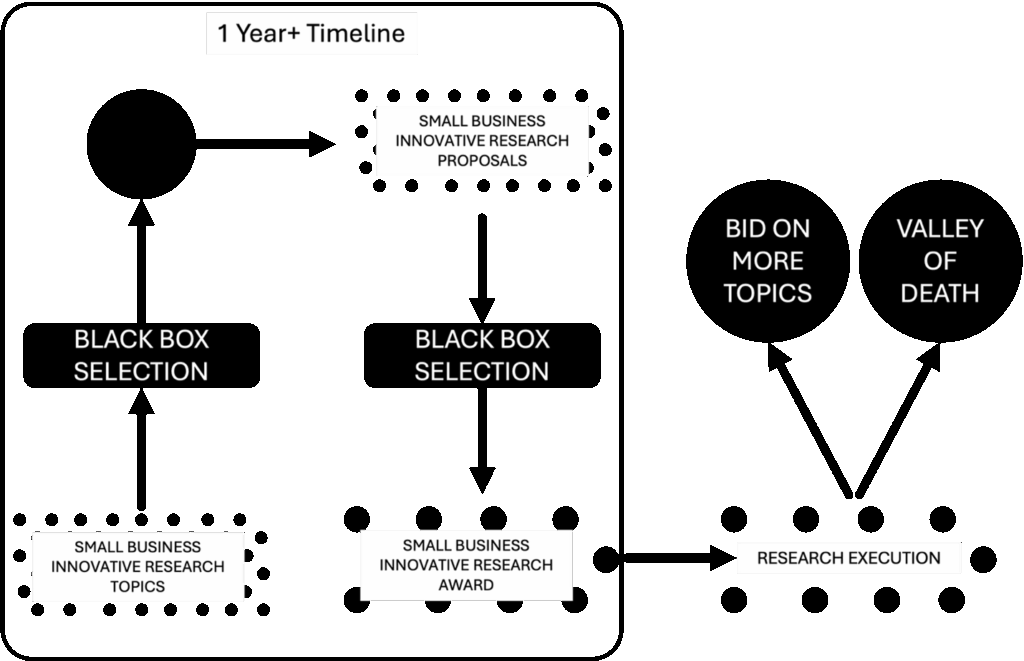
Image 2: The Broken Process
What to Keep
Despite its flaws, the Small Business Innovation Research program is of vital importance for our nation’s small business defense companies. It currently serves as one of the only entry points into the defense market for small, non-traditional companies. Since agencies program the lion’s share of research, development, test, and evaluation dollars under institutionalized acquisition programs and route most of those dollars to incumbent primes for system acquisitions, Small Business Innovation Research at least offers an entry point, albeit small, that may provide a narrow path to those program of record dollars. Furthermore, this program’s sole source “Phase III” contracting authorities give companies and procurement professionals flexible and responsive instruments to acquire emergent capabilities. These instruments bridge many temporal barriers presented by larger contracting vehicles and should remain intact. Small Business Innovation Research also provides an entry point for investing capital in emergent gaps and needs that current programs of record do not cover or legacy primes cannot respond to.
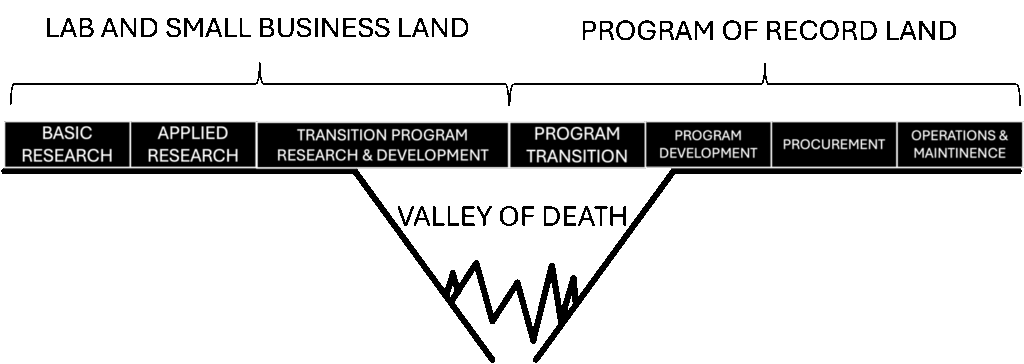
Image 3: Closing the Valley of Death
Clean Sheet Re-design
We propose a clean sheet re-design of the Small Business Innovation Research program that retains little outside of the statutory sole source Phase III authority from the current program. Our plan begins by setting up a dedicated, colorless funding line within each acquisition program — equal to 10 percent of its research and development budget — to support the transition of new technologies into active use. This flexible funding would allow existing programs for technologies to take root, helping program offices see these efforts not as isolated science projects, but as tools to deliver real capability.
More importantly, this would incentivize program offices to engage with emerging technology companies, conduct real market research (a rarity in sole-source major programs), and utilize funding under these programs as a mechanism to create momentum and solve difficult problems that the prime vendors cannot. Further, it would give the program offices control over the planning and execution of that funding towards solutions that actually impact their programs. This contrasts with the current status quo, where innovation funds, topics, and technical points of contact often come from outside the program offices and only loosely integrate with them or assist them, leading to friction between program offices trying to ensure their program succeeds and outside entities vying to go fast and field emerging technology.
Next, we turn to the Small Business Innovation Research and related innovation offices themselves, like AFWERX, SpaceWERX, Army Small Business Innovation Research, and Navy Small Business Innovation Research. They should stop acting as gatekeepers of the program and instead become smoothers of the path, eliminating barriers to entry by aiding in developing authorities to operate and certificates to field. Stop judging these offices by the number of topics they push and start judging them by the number of barriers they remove to accelerate fielding alongside the program offices and operators.
The Valley of Death image above shows a bridge on the program side because that’s where transition actually happens. The proposed consolidated transition function plus program element money is the bridge. Whether you see boxes or an arch, the point is structural: establish a landing zone where technologies can cross the gap and be received by the people who own cost, schedule, and performance. That is what closes the valley. It’s not a new label for the same cliff.
The new program should also automate topic development, selection, and compilation. This automation, ideally using AI with human review, should use plain language to identify the problem at hand instead of narrowly worded research topics that favor specific companies. This should involve end-user voting and crowdsourcing to draw on the wisdom of the operational end users, rather than relying on highly prescriptive topics written within labs. Review and approval must shift from a closed-door voting system to an open voting system that end users and stakeholders can influence. To close the gap between research offices and program offices and align interests, the program offices should participate in award selection. Additionally, the new program must enforce portfolio management and alignment — specifically with current or planned programs of record – to support investment-decision tools and decision making.
We also propose to apply a Rule of Two for sole source Phase III procurements under the new program. When an office publishes a market research announcement, and two or more companies respond with reasonable and valid evidence that their capability meets the requirement, the office should set aside the procurement for a sole-source Phase III procurement and move directly to negotiations and award. This policy encourages true market research and enables tech insertion, preventing over-reliance on prime vendors for in-execution solutions.
Now, the slush funds: They should be eliminated and their funds redistributed to program offices for transitioning projects under the new program into their program baseline. Funds such as Accelerate the Procurement and Fielding of Innovative Technologies, the Rapid Innovation Fund (now part of the Rapid Integrated Scalable Enterprise program), and funding for the Defense Innovation Unit should be the first to go. These funds are currently allocated on the wrong side of the valley of death, so redirecting them into transition elements within program offices would ensure the right people can make investments on the right side of the valley.
Furthermore, the new program must merge all Office of the Secretary of Defense innovation organizations, such as the Defense Innovation Unit, the Office of Strategic Capital, DEFENSEWERX, National Security Innovation Capital, National Security Innovation Network, NavalX, etc. into one institution with a clear mandate to invest and transition capabilities. This would replace the current menagerie of development organizations competing for operational problems, projects, performers, funding, bureaucratic turf, and transition. Finally, the new program must create a centralized AI-enabled Phase III marketplace. This marketplace would feature a clear listing of all projects awarded under the program, enabling acquisition program managers to automatically generate a sole-source Phase III contract in minutes and crushing the barrier of program managers and contracting officers generating government-mandated paperwork.
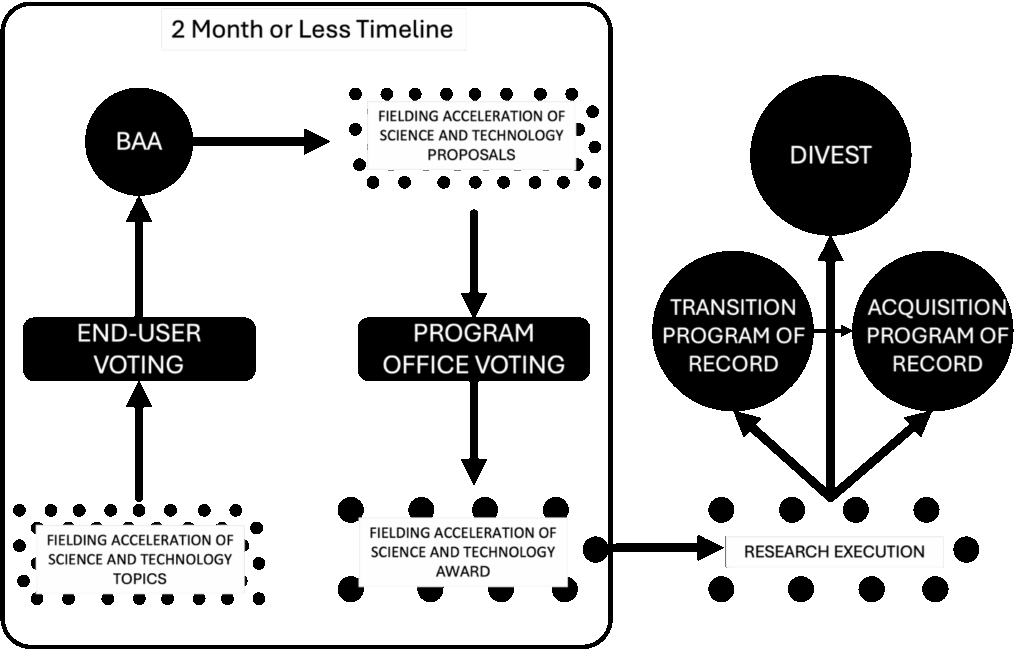
Image 4: A Fielding Acceleration of Science and Technology Process
Implementation Imperatives
To ensure the new program works, we must mandate several implementation imperatives.
First, align every topic to a current or future acquisition or science and technology program with a clear transition plan for technology insertion. When this alignment fails, participants waste money on pet projects, science fair curiosities, or legitimate science with no realistic transition path.
Second, ensure the aligned programs are given a clear 10 percent transition fund. This sequestered budget line, usable only for transitioning the new program’s tech on programs of record, will drive broader use of Phase III authority because it will be the easiest way to spend the funds annually.
Third, disqualify companies and technical points of contact that fail to maintain a 10 percent transition rate. This provides accountability and aligns incentives because participants should build and transition, not consume the program’s Phase I and Phase II funds forever.
Fourth, cap company and subsidiary Phase I and II awards from the program at $25 million as a programmatic failsafe. If a company cannot become solvent with a self-sustaining research and development pipeline after $25 million in seed investment, it should not continue to receive revenue support.
Fifth, disqualify entities that fail to provide meaningful feedback on program proposals. Claiming to cultivate non-traditional vendors while denying feedback that helps them sharpen offerings embodies Hanlon’s Razor in the new program.
Sixth, eliminate the current Open Topic and Open Prize programs and replace requirement/need/problem statements with open calls for solutions. These small-ball sideshows almost never scale to transition or procurement. If no program of record exists to receive a technology, you are funding development that almost certainly will not transition.
In addition to these core mandates, the program must mandate Contractor Performance Assessment Reporting System reviews for its programs. If the new program continues the Small Business Innovation Research status quo and deprives companies of this report card, it inadvertently disadvantages them when they try to scale beyond the new program. Finally, the program should implement a Government Performance Assessment and Reporting System. The ecosystem runs a merciless Contractor Performance Assessment Reporting System, but no complementary system for contractors to review their customers, and this new system will increase accountability for government customers.
Some will offer that merely ending the current Small Business Innovation Research program and moving all of the money back to program offices would realign incentives. Handing all research dollars to program offices would appear to solve misalignment, but it would also eliminate the very mechanism that brings new firms to the table. If this were a pure “program offices control everything” problem, we wouldn’t need Small Business Innovation Research at all — programs would already be scouting, funding, and fielding from their internal lines. They aren’t. Our design keeps Small Business Innovation Research’s entry function intact while forcing real demand on the program side through a carved-out, colorless 10 percent transition line in each program element, controlled by the program offices specifically to transition tech into their programs. That line creates the receiving dock; the scorecard makes it painful to ignore.
Many experienced acquisition professionals will say the labs already transition technology to program offices. In reality, Air Force, Navy, and Army research labs have the same issues transitioning and commercializing technologies, largely for the same reason: There are few landing zones in program offices for emergent technologies. The point of the 10 percent program-side set-aside is to move from “lab says – program office shrugs” to “program office must plan for insertion,” with real market research and real schedules. The design changes incentives so the people who can accept risk and deliver capabilities have both reason and resources to do so.
While it seems simple to talk about collaboration with end users as the solution to topic development and transition within the various innovation organizations under the current construct, it is not enough to tell those offices to collaborate with end users and program offices better. This new program must replace the old, closed voting rituals with end-user topic ownership, plain language problem statements, and open voting. Program offices then participate in selection so award portfolios align to actual programs of record. That sequence — topic intake → end-user voting → award → program-side transition spend — is what binds operators, program managers, and performers to the same outcome metric: barriers removed and capability fielded. Judge these offices by the number of doors they open and barriers they remove, not by how many topics they publish.
We are keenly aware that proposing a Rule of Two seems counter to government competition goals. Competition is a government value, but so are speed and mission outcome. Phase III sole source authority already exists for Small Business Innovation Research technologies — what’s missing is the impetus to use it. Our proposal to apply a Rule of Two trigger to Phase III efforts under the new program doesn’t nullify competition — market research still tests capability fit and price realism. It does, however, flip the default from waiting for a multi-year indefinite delivery-indefinite quantity contract to negotiating now with qualified small businesses. That is how you compress timelines with negligible additional risk. Formalizing that trigger inside the ecosystem forces attention, creates muscle memory in program offices, and ties back to the 10 percent line that must be executed. Furthermore, imposing a Rule of Two in our proposed construct – with program offices given a set transition fund for their programs of record – would actually enhance competition. Most major programs of record are already sole-sourced to a prime contractor and have been for years. The program office’s easy button is a Justification and Approval that a C-5 could fly through, most often resulting in continued “only one responsible source” gravy trains for the typical prime vendors and no clear path to that program for anyone on the outside. The Rule of Two, coupled with the proposed intentional funding, would provide a forcing function for program offices to re-examine what “only one responsible source” really means, drive an impetus to actually implement modular open systems approaches to decompose larger requirements, and provide a discrete fund to make it all work.
While well-intended, the so-called bridging funds have led to scattering pots of money throughout the research side of the gap that hid the gap instead of fixing the problem. We propose to fold those dollars into program-side transition accounts and stand up a centralized, AI-enabled Phase III marketplace so program managers can discover prior work and generate compliant awards in minutes, not quarters. Fewer performative bridges, more actual crossings.
We also recognize that the Defense Department can make most of these changes without legislation. In fact, it would be better to maintain the department’s autonomy instead of requiring congressional action. We hope that these recommendations can spur those changes in the department ahead of any legislation.
The heart of this paper is not a screed about slush funds or innovation theater. It is a hard admission that the current system’s weak link is the human connection between problem definers, topic gatekeepers, and the people living with the operational pain. Our proposed changes elevate that connection from a slogan to a forcing function. The 10 percent program-side transition allocation and associated scorecard pressure are designed precisely to pull attention to what end users actually need, not to feed more money into disconnected front doors. The Department has fifty of those already, and they do nothing without a program-side landing zone and accountability to use it.
This paper charts a path to make the Small Business Innovation Research program effective by tearing it down and rebuilding it into what it should be – a new program that fixes the foundational issues with the current one. However, the strategy fails to confront the wider challenges across the defense research and development ecosystem. To deliver meaningful and durable change, we must combine the rebuilt program with a comprehensive effort that revitalizes the entire ecosystem. Research and development for its own sake wastes intellectual capital, time, and resources. This is a national security issue we must attack now. America’s adversaries aren’t waiting.
John Ferry is a former Green Beret, infantry officer, and combat veteran who has spent more than 15 years in the defense acquisition and technology community supporting organizations like the Army G3 and the Defense Advanced Research Projects Agency. John is the co-owner and president of Trenchant Analytics, the government contractor that built acqbot.com (ACK-Bot), the AI-powered platform for acquisition and contracting automation, in partnership with the Air Force Research Laboratory, Air Force Lifecycle Management Center, Air Force Sustainment Center, Department of War, Chief Digital and Artificial Intelligence Office, and other Government stakeholders. John holds a Master of Public Policy and Bachelor of Business Administration.
Joel Graley is the co-founder and CEO of ZDEN Technologies: a small defense company focused on integrating new capabilities into legacy defense platforms. Joel served for over ten years in the Air Force as an acquisition professional, supporting all phases of the acquisition lifecycle for several aircraft and weapons programs. After separating from active duty, he founded ZDEN with Dr. Zac Dennis and has spent the last two years developing AI and open architecture technologies, novel acquisition and engineering approaches, and key partnerships to crush the status quo for time to fielding new technologies to the warfighter. Joel holds a Master of Business Administration from Ball State University and a Bachelor of Science in Economics from the US Air Force Academy.
Image: Midjourney