Keep the Middle East at Arm’s Length with Airpower
There are clear applications for massed landpower in Europe and Korea – not so in the Middle East.

Following the Gulf War, the United States entered a long containment phase for Iraq, relying heavily on two no-fly zones (NFZs) to limit the regime’s ability to threaten Kuwait or Iraqi Kurdistan. In retrospect, these air operations were not only significantly less costly than the massive ground operations that followed, but they obtained better results. The contrast between the air-only containment efforts and the ground-heavy invasions is stark. Air campaigns were successful in containing Iraq, protecting Kurdish and Shia civilians, and unseating the Taliban government in Afghanistan. Civilian casualties were minimal and sporadic. As I have discussed here at War on the Rocks and a recent article in Air Force Magazine, these air operations were far more economical than the ground-heavy approach taken in Iraq and Afghanistan after 9/11, had a much lower footprint, and were well-supported by existing bases. Air operations could be successful again at containment, as Operation Inherent Resolve is proving to be.
Current operations in the Middle East have come in for a substantial ration of criticism, particularly with respect to is the Islamic State. Iraqi government forces have folded under relatively limited pressure, first in Mosul and most recently in Ramadi. The slow process of stiffening ground forces and the limited objectives of the air campaign do not appeal to observers who lack strategic patience. As such, the American preference for a decisive battlefield defeat of the enemy may be reasserting itself. This is unfortunate because the air campaign is working well enough to allow the Kurdish Peshmerga to retake lost territory, and airpower decisively defeated the ISIL assault on Kobane. Airpower is successfully containing the Islamic State at an affordable cost in treasure with no U.S. military casualties to date. This puts it well ahead of the costly and strategically ineffective ground campaigns of the last decade and a half. In an environment where the United States does not want and cannot afford to become embroiled in another ground-centric quagmire, airpower offers a proven method of containing the threat while simultaneously keeping it at arm’s length. Absent a new American desire to establish itself as an imperial conqueror, airpower offers our most flexible, affordable and cost-efficient option for military operations in the Middle East. The Islamic State is a long way from being defeated, but properly employed airpower has helped contain its advances, constrained its operations, and handicapped its logistics.
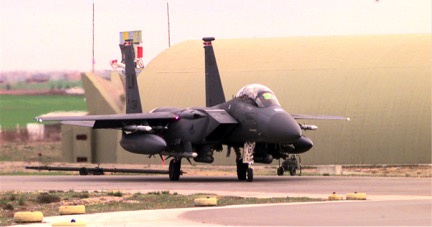
Our experience with airpower makes a solid case for moving back towards an airpower-centric approach in the Middle East. The U.S. Air Force presence in the Middle East dates to the invasion of Kuwait. As soon as Saudi Arabia requested assistance, the First Fighter Wing, already alerted, was given the deployment order. Twenty hours later a fully armed squadron of F-15Cs was airborne from Virginia; the first fight transited to Dhahran in 15 hours and a whole squadron was on the ground 19 hours after the first jet launched from Langley AFB. Eagles were on alert in the desert within four hours after the last flight touched down. By the time the 82nd Airborne’s ready brigade completed its move five days later, there were 14 B-52s, five fighter squadrons, and an airborne warning and control system (AWACS) detachment in place. Operation Desert Shield was rolling, and air combat assets got there first. After Operation Desert Storm, the first U.S. Army units arrived home within 60 days, but the Air Force never left. The U.S. Air Force has sustained a continuous deployment of combat aircraft in the region for over 9,000 days. From 1991 to 2003, U.S. and allied aviators successfully contained Iraqi ambitions with no coalition fatalities at a cost of less than $1.5 billion per year, compared to the over $800 billion spent on Operation Iraqi Freedom. Airpower-only containment operations had far better outcomes for far less blood and treasure than the ground-centric Iraqi Freedom or Enduring Freedom.
For a status-quo power like the United States, airpower is a much more flexible and sustainable military option in the Middle East or Southwest Asia. Air forces can shift operational areas rapidly without relocating. Most importantly, over 350,000 sorties were flown in the NFZs without a single U.S. casualty due to hostile fire. By contrast, any ground commitment will automatically require longer deployment and redeployment timelines, heavy logistical support, and a massive commitment of funding and lives.
Admittedly, there are practical limits to military power. In 2001, the expectation for Operation Enduring Freedom was that we could partner with local forces to remove the Taliban from power in Afghanistan and neutralize Afghanistan as a base for global terrorist operations. We achieved those goals by the close of 2001 and followed up with ground operations in Afghanistan and later Iraq to secure territory, establish governance, and assure the emergence of U.S.-aligned states with democratic trappings by winning “hearts and minds.” This was fantastically optimistic, given that the United States had failed this same task in Vietnam. In hindsight, the United States would have been far better served by not establishing large ground footprints in either country. Instead, it should have enabled proxy forces – a technique Iran is using successfully today.
The United States must accept that there are limits to the effects that can be achieved with any kind of military power, and that differing forms of military power come with substantially different risks and costs. In all cases, the use of mass ground forces is the option that is likely to be the most expensive, least flexible, and entails the most casualties over the longest duration. There are clear applications for massed landpower in Europe and Korea – not so in the Middle East.
The United States still has clear national interests in the greater Middle East, including the security of Israel, combatting Islamic extremism, the containment of Iran, and securing NATO’s southeastern flank. None of those objectives requires the presence of ground forces engaged in either direct combat or large-scale occupation, when other alternatives are so clearly available. With the exception of advisors and prepositioned equipment maintenance, long-term U.S. military operations in the Middle East should not involve U.S. ground forces at all. Realistically, we don’t need them there. American allies in the region are militarily and economically formidable, and not under the constant Soviet threat typical of the Cold War. Iraq poses no credible military threat and Iran’s conventional forces are weaker, comparatively, than at any time since the fall of the Shah.
With the United States no longer required as the sole guarantor of the region’s security, we can afford to reconsider what kind of commitment the United States makes to the Middle East. Absent the emergence of a credible existential threat in the region, the future commitment should not involve any significant number of ground combat forces that do not come from the local powers themselves.
The demonstrated success of airpower application since Desert Shield, contrasted with the comparative lack of strategic success demonstrated by the ground campaigns of Operations Iraqi Freedom and Enduring Freedom, should impel the U.S. towards more limited, achievable goals that are realistic within the context of a disintegrating regional order. The United States should first turn to the patient application of airpower to stabilize the region and to achieve policy goals while keeping the increasing regional disorder, and its effects, at arm’s length.
Col. Mike Pietrucha was an instructor electronic warfare officer in the F-4G Wild Weasel and the F-15E Strike Eagle, amassing 156 combat missions and taking part in 2.5 SAM kills over 10 combat deployments. As an irregular warfare operations officer, Pietrucha has two additional combat deployments in the company of U.S. Army infantry, combat engineer, and military police units in Iraq and Afghanistan. The views expressed are his alone and do not necessarily reflect the official policy or position of the Air Force or U.S. government.
U.S. Air Force photo Senior Airman Michael Battles


Also, my apologies, I wrote that comment in a worksheet and selected all before pasting, so the links at the top are irrelevant to the rest of my comment.
As my original comment seems to be deleted, I’ll make another attempt and, in so doing, attempt to be less verbose and abrasive. As with the author’s other WOTR offerings, I’m concerned that the author’s argument is premised on inaccurate historical examples. For example, the no-fly zones over Iraq between 1991 and 2003 were effective in preventing the Hussein regime from using air assets to commit human rights violations, but the Hussein regime found other ways to maintain its domestic reign of terror, circumvent sanctions, and destabilize its neighbors; as such, the air campaign the author cites was not decisive, and Iraq remained one of the most prominent international security concerns, requiring a large contingent of American forces in the Gulf thereafter. He similarly misrepresents the early air campaign in Afghanistan, which served merely as a supportive adjunct to a combined force of U.S. Army Special Forces, CIA paramilitary operators, and the Northern Alliance; the result was tactically brilliant and strategically inconclusive. Operation Inherent Resolve has similarly been a mixed bag. Air power is certainly an important element of America’s national power, but it has consistently failed to live up to air power advocates’ pronouncements of its disproportionate strategic effectiveness. (The high costs and strategic ineffectiveness of America’s recent land campaigns is another matter entirely, and I would argue that those examples demonstrate opportunities for improvement in the way America conducts its ground wars, rather than recommending a false dichotomy between land and air campaigns.) America’s interests in the Middle East will persist into the foreseeable future, and those interests will continue to require all of the capabilities of the joint force in order to reinforce both positive security assurances for America’s allies, negative security assurances for America’s enemies, and, in some situations, actual operations on land, sea, and air to pursue strategic goals.
Good points Tom. With regard to fighting ISIS, I wonder if there are areas in Iraq where we can airdrop troops so as to disrupt ISIS supply lines. By situating them in small towns or open areas, ISIS forces would have to expose themselves to attack from the air. They would also have to pull troops from their front lines, thus weakening them to attack from Kurdish and INA forces.
As much as I like the idea of going on the offensive against IS, creating isolated outposts meant to draw the enemy out into the open is a strategy that has backfired many times in the past, and led to encirclement (as well as tactical and strategic defeats) for the attackers. Dien Bien Phu comes most prominently to mind, as well as the logic behind the Marine base at Khe Sahn in 1968.
Attacks aimed at an enemy’s supply lines over work if you are menacing his front as well, so that you create a situation whereby he has no good options. Absent a meaningful ground threat (from either US or local allies), dropping small teams of ground troops in IS’s rear would most likely lead to a debacle like Mogadishu.
This article simply moves goalposts to achieve “victory”. The goal of the as another commenter points out- the goal in the interwar period was containment. The goal in OIF was removal. Remember “Shock and Awe”? The rapid dominance campaign that preceded the actual invasion? Didn’t work. As has been demonstrated repeatedly, countries can sustain prolonged air-campaigns, even ones much, much longer. The fact is that airpower didn’t remove Saddam, which was the intent, demonstrates the failure of air-only campaigns. If the author wants to argue that the strategic invasion of Iraq was a mistake, he’ll get no argument from me (I’d also like to point out that the USMC said it was a mistake at the time as well). But that was a difference in strategic objectives, not because Airpower was just so amazing.
It’s also incredibly disingenuous to talk about the deployment times to the region. He compared moving roughly 40 aircraft to pre-existing bases, to moving a brigade worth of combat infantry into pre-invasion battle positions. Not to mention the author ignoring the necessity of special operations in conducting the tactical air campaigns during OEF.
What irks me the most about this article is that the author is technically not wrong in his facts, just that he uses false comparisons. It’s like when people point out that we had 5 times as many ships in 1900 as today. Technically true, but I’d rather have a Gerald Ford battle group than 100 dreadnaughts.
First, an excellent article containing strategic common sense so often lacking. well Done.
The author is correct that “the American preference for a decisive battlefield defeat of the enemy may be reasserting itself,” which is always amazing given the fact that absent the First Gulf War the U.S. has failed to achieve successful strategic results in any post World War II ground campaign we have conducted in Asia (including in its Southwest Area known in the U.S. as the Middle Est.)
The First Gulf War was fought under political conditions tailored made for a short and successful conflict, especially given that this nation’s political and military leadership understood the need to contain and limit that effort – whether or not a ground campaign was or was not required to obtain the aimed at result. For those who have forgotten, the Chairman of the Joint Chiefs of Staff, Army General Colin Powell was not in favor of using military force to obtain the nation’s aimed at political goals. However, the ground campaign certainly speed up achieving the aimed at end result. And, the Saudis paid most of the cost of that effort – if I recall correctly.
The Colonel is correct, “There are clear applications for massed land power in Europe and Korea – not so in the Middle East,” nor in what appears to be this country’s executive aimed at confrontation with China in waters and lands surrounding that Nation. Even on the Koreans peninsula, the U.S. should not enlarge its ground presence given the rather large, well equipped, and well trained ROK forces more than capable of defeating the north Korean forces in land battles – should that occur. On the other hand should the U.S. so wish, we could enhance South Korea’s competitive and defensive situation through increased presence of anti-missile capabilities based on ships and by an increased U.S. Air Force presence in that region.
Further, the Colonel’s assessment is accurate when he notes that:
“With the exception of advisors and prepositioned equipment maintenance, long-term U.S. military operations in the Middle East should not involve U.S. ground forces at all. Realistically, we don’t need them there. American allies in the region are militarily and economically formidable, and not under the constant Soviet threat typical of the Cold War. Iraq poses no credible military threat and Iran’s conventional forces are weaker, comparatively, than at any time since the fall of the Shah.”
What the U.S. does need to do in that area is to realize that, first, we should be directly equipping and if necessary training the Kurdish Forces; and do so regardless of whether or not the Turkish Government and the Iraq (Baghdad) government likes it or not. The U.S. should not be led around by the radical political dreams and whims of Erdogan and Company in Turkey who are aiming at establishing a second Ottoman Empire. We could also work more closely with the Saudis and the Jordanians and, as others have suggested, perhaps encourage and assist them with (air power and logistical) support to move into and take over the Sunni areas of (all but dismembered British created) Iraq. Just leave the retreating ISIS forces a path into Syria where they can battle with Assad’s forces and their Russian, Iranian, and Hezbollah allies. That would run the costs up for those parties, drain them of their manpower, and eventually provide a weakened situation on both sides of that conflict enabling the Saudi and Jordanian Forces to overrun that area.
As the Colonel is suggesting, the U.S. needs to remain patient, have a long run view of the problem in the Middle East, and achieve its goals without the politically and militarily disastrous approach of inserting a large western (American) ground force into that area which will galvanize support for our regional competitors. We should remember, this country has repeatedly failed to achieve its political goals when inserting large ground forces into Asia (and the British Colonial Office entitled Middle East). The peoples of the world will no longer accept occupation and rule by foreign military forces on their land, and they have learned how to protract that conflict and strategically defeat the American occupying force – even if takes the well over a decade to achieve that result. The U.S. can no longer afford trillion dollar plus investments in strategically failed occupations such as recently occurred / is occurring in Iraq and Afghanistan. America’s habit of claiming tactical success was ours, therefore the strategic failure was worth the cost is placing us on an absurd path to weakness and failure.
It is time for the Officers and others in command in the DOD to throw out the study of Clausewitz and to begin studying and adopting the philosophies and principles Sun Tzu and other wise Chinese philosophers of war if we wish to return to experiencing strategic success.
Author forgets the political consequence extended IS control of territory has regards its time to improve its depth in the population and spread its ideas, and the political consequences of civilian causalities both regarding the views of the local population and Muslim people internationally. IS is winning in the intangible sphere even if it is losing men and equipment in the physical sphere, and it isn’t losing enough men/equipment to totally contain it or push it back.
Two things to point out – the situation in the Middle East cannot be “resolved” – at least not by any outside parties. It is to be ultimately resolved by those in the Middle East themselves, nobody else. This is something many of us have yet to come to terms with and the comments to this article are demonstrative of that mindset (or lack thereof). The author of this article, however, has come to terms with that fact, which is precisely why he titled his piece “Keep the Middle East at Arm’s Length…” Since it has become blatantly obvious that direct intervention in the Middle East is a no-win proposition for the U.S. and its allies, the best (and only way) to protect ourselves from the chaos in the region is to contain it. Direct intervention (“boots on the ground”) only exposes us to further peril. Our military’s greatest edge resides in our air, sea, and space capabilities and special operations forces; its high time we exploit these advantages. Ultimately, anything we do in the Middle East needs to be aimed at serving our interests and we do so best by keeping the trouble contained within the region. There does not always need to be a campaign to “win.”