Join War on the Rocks and gain access to content trusted by policymakers, military leaders, and strategic thinkers worldwide.

Is Pakistan undergoing a “shocking strategic shift” away from its long-standing India-centric policies and preference for supporting non-state proxies? That is just what Sameer Lalwani provocatively argues in a recent article. He claims that the prevailing characterization of Pakistan as a “belligerent, unyielding, and destabilizing force in international affairs” has obscured an important “reorientation of Pakistan’s national security policies.” He describes three inter-locking shifts that warrant examination: that Pakistan is reducing its bellicosity toward its long-time foe India, turning inward to address domestic security threats instead of continuing its competition with India, and re-examining its very strategic culture in the process. I wish it were so, but unfortunately Lalwani’s arguments are far more shocking than Pakistan’s putative strategic shifts. The latter have yet to occur and, indeed are unlikely to occur in any policy-relevant time frame. Rather than seeing in Pakistan what they wish to see, the United States and its partners must see Pakistan for what it is and plan accordingly.
Faux Shift 1: “Aggressive” or “belligerent” Pakistani behavior toward India has been significantly reduced.
Lalwani asserts a significant diminution of Pakistan’s aggression towards India. To buttress his claim, he contends that “Overall violence on the Indo-Pakistan border has declined due to substantial reductions in militant activity and cross-border firings, based on open-source data, including that of the government of India.” Lalwani’s data must be put in context, and once we do that the argument that Pakistan’s belligerence has significantly reduced begins to fall apart.
First, it is true that Pakistan made an effort to rein in its proxies, thereby contributing to a reduction of hostilities in Kashmir. But this restraint was under severe U.S. pressure. The United States was focused upon fighting its war in Afghanistan and wanted to minimize any possibility of a conflict between India and Pakistan, which would justify Pakistan swinging its troops from the west to the east. Such a maneuver has precedents. It happened after Jaish-e-Mohammad’s December 2001 attack on the Indian parliament and the May 2002 attack on army families by Lashkar-e-Taiba in Kaluchak, Kashmir and the ensuing Indian military buildup upon the border. Second, this reduction was never supposed to be permanent. Pakistan was forced to put Kashmir on the “backburner” while it sought to develop new strategies in South Asia while keeping the India-focused jihadi movements in cold storage.
It is worth noting that Pakistan’s military has actually escalated its rhetoric on Kashmir in recent years, in opposition to Lalwanis’s claims to the contrary. General and President Pervez Musharraf famously dropped Pakistan’s long-standing (and unfounded) demand for a plebiscite in Kashmir, according to which Kashmiris were to decide whether they want to join India or Pakistan. Pakistan—despite its support for this option—violated the first, necessary but insufficient condition for the plebiscite by refusing to de-militarize Kashmir. It was Musharraf who also agreed to the 2003 ceasefire and offered India a number of options to resolve the Kashmir dispute, all of which legitimized Pakistan’s varied equities in some measure. There was never any chance of India accepting these offers because India remains committed to ratifying the status quo and is loath to validate any of Pakistan’s claims. Thus there were never any real costs imposed upon Musharraf in offering these putative “concessions.” Moreover, doing so made Musharraf appear more statesman-like in the eyes of the international community, which was convinced Musharraf was a man of peace in the region and beyond.
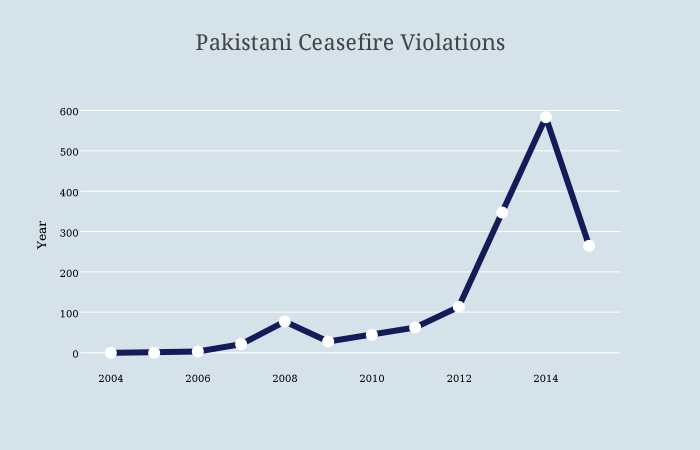
Many of these policies disquieted the army’s other senior generals. As soon as Musharraf left the scene, under pressure from those same generals, his successor General Ashfaq Kayani reversed Musharraf’s policies. Under Kayani’s tenure as army chief (November 2007-November 2013), Pakistan reverted to the outrageous plebiscite demand and resumed hostilities in Kashmir, as evidenced by Figure 1. The current army chief, Raheel Sharif, has persisted with Kayani’s rhetoric and has repeatedly emphasized that Kashmir is the “jugular vein” of Pakistan and remains the unfinished business of partition.
This brings me to my second point. In 2003, both sides agreed to a ceasefire in November 2003. In both 2004 and 2005, there were no “ceasefire violations.” As the below chart attests, Pakistani cease fire violations have grown steadily since 2009. Lalwani concedes this uptick but dismisses it as largely irrelevant because the violations have not hit the historic highs of 2002, which numbered well over 5000. Lalwani says that this diminution in hostility is due to a major “strategic shift” in Pakistani calculus, arguing that while “Pakistan still supports Kashmiri separatists … infiltration attempts, violent incidents, and fatalities have all steadily decreased by over 90 percent since 2001.”
What Lalwani does not explain explicitly is why Pakistan engages in such shelling. Historically, under the cover of shelling, Pakistani militant groups infiltrated into India either across the line of control or the international border. Shelling served the purpose of infiltrating militants through a particular sector. What then accounts for this increase since 2009? Does it matter that this remains about one tenth the level of shelling in 2002? Maybe not. As I describe below, Pakistan has long developed new routes of infiltration that are less dependent upon the old standard of “shelling” to provide cover to the militants who squirt into India.
Third, and related to the second point, Lalwani is correct: there has been a shift in Pakistan’s calculus, but it is not necessarily the shift he had in mind. As the Line of Control (LOC) became more difficult to penetrate and subject to considerable international scrutiny, Pakistan developed alternatives routes to cause mayhem in India. Pakistan, and its proxies such as Lashkar-e-Taiba (operating under the guise of Jamaat ud Dawa and Filah Insaniat Foundation), have cultivated the territories and citizens of Bangladesh, Sri Lanka, Nepal, Thailand, European and Arab Gulf States to recruit militants, raise funds, organize documents, secure weapons. Pakistan has used Bangladesh and Nepal as infiltration routes as well. .This is in addition to infiltration by sea. More importantly, for Pakistan’s security managers and the militants they support, Kashmir is but a gateway to the ultimate prize of spreading communal discord in India. To this end, Pakistan has cultivated the Indian Mujahideen (IM), an indigenous jihadist movement that Pakistan has supported with safe haven, money, and training, among other things.
Faux Shift 2: Pakistan is gradually pivoting away from competing conventionally with India to turn inward and seriously tackle domestic threats.
Lalwani next claims that a “strategic reorientation” away from conventionally fighting India towards its myriad domestic threats. While Pakistan’s military has been engaged in military operations in the tribal areas with mixed results and dubious resolve, there is no reason to believe this represents a strategic shift as he intimates.
Lalwani asserts that such a shift “is evident in Pakistani defense resourcing, procurement, deployment, and operational choices since 2001. Based on open-source data, defense allocations declined substantially over three decades.” There are several problems with this claim. First, he cites data from the Stockhom International Peace Research Institute (SIPRI) and the International Institute for Strategic Studies (IISS) to buttress these claims. Both SIPRI and IISS maintain data on military force structures and expenditures; however, SIPRI and IISS data are only as good as Pakistani reporting on these issues. Alas, Pakistan’s defense budgeting is notoriously opaque as is information about its force structure. (Readers should compare multiple years of IISS data to learn how slowly their reported figures change, likely reflecting poor information in the first instance.) Pakistan’s military does not submit detailed budgets to the parliament, obscures defense spending by locating them in other parts of the budget, has considerable off-budget activities, and does not account for its nuclear program in its budget. Thus there is virtually no way to sensibly comment comprehensively upon Pakistan’s defense budget. In recent years, the military has submitted more details about its requirements. While this is an improvement it is a far cry from the transparency observed in democracies with civilian control over the military. Equally important, it is impossible to garner insights into Pakistan’s crucial financial relationship with Saudi Arabia.
Second, he contends that Pakistan’s procurements of weapons systems are consistent with this assessment. He notes that the “rate of major weapons procurement and replacement has slowed considerably. From the 1950s through the 1990s, Pakistan’s offensive arsenal (tanks and combat aircraft) grew roughly 50 percent per decade, but in the 2000s, this growth slowed to roughly 7 percent.”
There are historical reasons for this, as Lalwani surely knows or should know. After partition, Pakistan’s army was in a shambolic state. The British Indian Army had an end-strength of 400,000 personnel, of which less than 150,000 would go to Pakistan. Pakistan inherited no complete units and suffered an acute officer shortage. (For this reason, Pakistan retained British officers well into the 1950s.) All of the major ordinance and production plants were in India. Pakistan was desperate to capitalize—not recapitalize—its armed forces. After wooing the United States from 1947 onward, the United States finally agreed to bring Pakistan into its alliance structure in 1954. Pakistan’s main goal in that partnership was grow its military and the capabilities of its armed forces. Despite turbulence in U.S.-Pakistan relations from 1965 to 1982, the defense relationship again resumed. Pakistan took advantage of being a front-line state in the anti-Soviet jihad to massively expand its army. By 1989 the army had reached an end-strength of 450,000.
Consistent with this tripling in size between 1947 and 1989, Pakistan had to restructure the organization. At independence, all of the army’s divisions were commanded from the General Headquarters in Rawalpindi. Pakistan added I Corps (now located in Mangla) in 1957. The IV Corps (Lahore) was formed in 1965. Several Corps headquarters (II, V,X, and XI) were added in the 1970s, and several others (XII, XXX, XXXI) were added during the 1989s. The current army is comprised of nine corps and the Strategic Forces Command, which was created in 1999 to exercise command and control over Pakistan’s nuclear arsenal. The current Pakistan army has an active strength of about 550,000. Clearly, the rate of expenditures should have declined because the bulk of the growth occurred during the periods described above. Moreover, the vast majority of the weapons systems that Pakistan has acquired from China and from the United States are designed to combat conventional enemies—not domestic ones.
How is this a “strategic shift”? Lalwani notes that Pakistan has not attained “conventional parity” with India. He implies that because Pakistan does not seek to attain such parity with India, that Pakistan is more concerned with domestic threats. First, Pakistan does not seek to attain conventional parity with India because it cannot. Second, it does not seek overall conventional parity because it need not do so. Pakistan need only have parity along the international border with India and the LOC. Indeed, along these terrains, both states are relatively evenly matched. Pakistan’s military doctrine assumes that India’s massive conventional advantages begin to kick in only over the course of a long war when India can move its assets from the east to the west. Pakistan believes that the nuclear arsenals of India and Pakistan will force the international community to intervene early in the conflict, if the arsenal fails to prevent a conflict in the first place. Indeed, this is how Pakistan gets away with using terror as a tool of foreign policy: nuclear weapons raise the cost of Indian retaliation and force the international community into the crisis cycle before a full-blown war can erupt.
Turning to Lalwani’s assertion that the Pakistan’s military now understands the magnitude of its domestic militant threat, here too the evidence is thinner than Lalwani concedes. First, if Pakistan were truly of the view that domestic Islamist militants are the threat Lalwani claims, we should see evidence of Pakistan shutting down the myriad Deobandi militant groups that give manpower to the Pakistani Taliban. Here, we see no evidence. (Since Lashkar-e-Taiba does not attack Pakistanis and operates under ISI’s command and control in India and Afghanistan, the army’s continued fostering of that group is not inconsistent with the kind of shift Lalwani posits.) So what does account for Pakistan’s military operations in South Waziristan and elsewhere?
To understand what Pakistan is doing, it is important to understand what Pakistan is not doing. First, Pakistan is not abandoning the strategic utility of Islamist militancy simply because it is experiencing blowback from this policy. While Pakistanis are wont to blame a variety of external actors for its domestic insecurity, it is a simple fact that there would be no Pakistani Taliban had there been no Afghan Taliban, Jaish-e-Mohammad, Sipah-e-Sahaba-e-Pakistan and the like. All of these groups were and, to varying degrees remain, assets of the state. The state has at best waged a selective war against those elements that cannot be coerced or cajoled back into the fold of the ISI.
What Pakistan is trying to do is regain control over these varied assets gone wild. Many in the Afghan Taliban reject Pakistan’s efforts to manipulate the movement and are as hostile to Pakistan as they are to the Americans. Pakistan needs to divide and conquer the emerging Taliban factions as soon as possible if it hopes to have any reasonable ability to dictate the future of Afghanistan. Turning to the Pakistani Taliban, Pakistan has been trying to persuade some commanders to rejoin the fight in Afghanistan while trying to persuade others to rejoin the fight in India. This is why Pakistan has resuscitated Jaish-e-Mohammad, a Deobandi militant groups raised to kill Indians. Those militants who cannot be rehabilitated to support state goals can only be eliminated.
Finally, if Pakistan were serious about the nature of its domestic threat, we should expect Pakistan’s military to be more forthright in describing the terrorists who are savaging Pakistanis. Here too, we see considerable evidence of Pakistani perfidy. Pakistan’s intelligence agencies go to considerable effort to orchestrate a media message that these militants are not Muslim. Pakistan’s media is rife with reports that these terrorists are not circumcised, indicating that they are “Hindu” or “Indian agents.” As is well known, Mehsuds (a tribal from the Federally Administered Tribal Areas) do not circumcise and they swell the ranks of Pakistan’s domestic terrorists. Even the notorious attack on a Peshawar school was immediately described by Pakistan’s media (as well as former President Musharraf) as an Indian conspiracy.
As I argue in my own book, Fighting to the End: The Pakistan Army’s Way of War, Pakistan uses this strategy to intrinsically link its internal strive to its conventional foe: India. This is how Pakistan’s army continues to legitimize the need for a large conventional army even though the numbers of Pakistanis killed by domestic terrorists since 1988 outnumber, by an order of magnitude, the 9,000 battlefield deaths from all Indo-Pakistan wars in 1947, 1965, 1971 and 1999 combined. If Pakistan’s army is genuinely serious about the nature of its domestic militants, it would discontinue this canard of blaming India for these attacks, thus fostering the perception that Pakistan’s conventional nemesis is the cause of Pakistan’s internal insecurity.
Critically, Pakistan gains materially from these internal operations. Pakistan argues that as long as it is “killing terrorists,” it should continue receiving American subsidies for doing so. This argument has some merit: unfortunately, the United States has not insisted that Pakistan cease its efforts to create terrorists elsewhere. Essentially, Pakistan has turned its war on terrorism into an endless revenue stream.
Faux Shift 3: A fundamental evolution in Pakistani strategic culture appears to be underway.
Lalwani claims that “Pakistan’s officer corps and national security experts have engaged in significant self-examination in their strategic literature over the past 15 years.” His evidence for this is thin and based upon a highly selective reading of Pakistan’s defense publications which I have treated in my own book Fighting to the End: The Pakistan Army’s Way of War. Having read through all of the publications he cites and hundreds more, I find it difficult to agree with him. In fact, heaving perused six decades of the army’s publications, I find considerable evidence that the army seeks to construct its conflict with India in ideological, rather than strategic or military, terms. This lays the foundation for a civilizational war with India that has no end. This buttresses the army’s ideological, organizational and material objectives of remaining the single most important organization within Pakistan and protects the rights it arrogates to itself to run and ruin the country when it feels compelled to do so.
It is possible that Pakistan’s military is undergoing a strategic shift although Lalwani does not provide genuine evidence for this claim. After all the Pakistan army has been fighting its own people since 2002. While Pakistanis may believe they are killing Indian agents with their foreskins intact, the men in uniform know full well whom they are killing and who are trying to kill them. Whereas before 2002, most Pakistani army unit losses occurred in some context or another that involves fighting the Indian enemy. Since then, increasingly unit losses are coming at the hands of Pakistanis. Such a situation would discomfit any military as no military embraces the concept of killing its own citizens over prolonged periods of time.
Another important driver of potential change in the Pakistan army is its base of recruitment, which now stretches well beyond the Punjab. As I have shown elsewhere, the districts from which they are recruiting have very different beliefs and values from the traditional bastions of recruitment. These officer recruits come from districts that do not share the “jihadi” commitments of those in the Punjab and they do not see India as the most important threat to the nation.
Taken together, these combat deaths in the tribal areas and Khyber Pakhtunkhwa and the shifting geographical bases of recruitment could auger important ideological shifts over time. However, armies are very good at managing social change. Individuals are incentivized to toe the organization line for purposes of promotion and postings. The Pakistan army offers serious enticements to those who stay in line, including lucrative land grants and an entire system of amenities including schools, hospitals and housing areas that civilians cannot access. Thus it is far from obvious that these recent pressures exposited above will produce the much-anticipated organizational changes that optimists, like Lalwani, hope for.
Much Ado About Nothing?
Unfortunately, Americans are constantly looking for signs that Pakistan has turned a new leaf. Every new army chief produces the same chorus of notables who argue that “This army chief is a straight shooter. We can work with him.” Alas, at the end of each army chief’s tenure, we learn that he was not substantively different than those he proceeded. Acknowledging the durability of the dangers that Pakistan presents seems to be too overwhelming for Americans. However, our efforts to see positive change where they do not exist come at a great cost. The United States must get over this idea that Pakistan can be a force for good in the region when the preponderance of evidence speaks to the contrary. Once the United States rids itself of this preposterous notion, perhaps it can get to the real business of crafting policies that will contain the multifarious threats that Pakistan pose to U.S. interests in South Asia and beyond.
C. Christine Fair is an assistant professor at Georgetown University’s Security Studies Program in the Edmund A. Walsh School of Foreign Service and a visiting scholar at the Gateway House in Mumbai, India. She is the author of Fighting to the End: The Pakistan Army’s Way of War and co-editor of Pakistan’s Enduring Challenges. The views here are her own and do not represent that of Georgetown or the Gateway House. The reader is advised that the author embraces sarcasm robustly.
Photo credit: Raza0007