Join War on the Rocks and gain access to content trusted by policymakers, military leaders, and strategic thinkers worldwide.

Judged by the initial strategic goals set by Russian President Vladimir Putin in 2022, Russia’s military lost its war against Ukraine some time ago. Yet Russia’s armed forces have not stopped fighting and continue to prosecute large-scale combat operations in a brutalizing, protracted war sucking up much of Russia’s assets of national power, from pure military capacity to foreign policy priorities to considerable societal and economic resources. While Putin calls the most important strategic shots, it is Russia’s senior military elite that makes the strategic and operational decisions impacting warfighting outcomes every day. Who are these senior officers, where did they come from, and who replaces them as the years tick on?
Although the traditional mandatory retirement age for top generals in Russia’s military is 65, the longstanding 70-year-old Chief of the General Staff Valery Gerasimov remains Russia’s top military officer, in part because of the elimination of age limits for senior Russian military and civilian positions in the Ministry of Defense several years ago. But Gerasimov will not be Russia’s top general forever. The next generation of Russia’s senior military leaders is being formed in the crucible of Russia’s war against Ukraine, and retirement looms for Russia’s upper-tier military elite soon, no matter how delayed it may be for a time under Putin’s increasingly gerontocratic system.
Furthermore, decision-making in the Russian military is not confined to the General Staff chief and immediate subordinates. Critical roles are played by service branch commanders-in-chief and their staff officers, who are responsible for the future planning and design of the forces under their control. Meanwhile, military district commanders and their staff, who are responsible for training and operational performance of the armies in their district territories, wield major influence on the groupings of forces that actually wage war in Ukraine today.
These senior officials are at the top of the wider pyramid of general and flag officers that comprise the Russian military elite, which can be defined as the “decision-making, decision-influencing, and decision-implementing individuals who plan and coordinate Russia’s wars and command Russia’s armies, navies, and other military forces.” They also coordinate the military’s role in executing Russia’s strategic and geopolitical goals in alignment with the Russian regime’s political leadership. Russia’s senior military officials play a key role in determining how Russia fights, yet patterns of promotion to top positions in the Russian military are poorly understood and rarely studied.
Building on our past work on leadership in the Russian navy, CNA has recently published a report examining promotion patterns in the Russian military elite. Our guiding research question was simple, if broad: What information can promotion patterns in the Russian military provide about the evolution of the Russian military elite? More specifically, what factors contribute to the successful promotion of leaders in the Russian military and what role do battlefield performance and other combat experiences play in military promotion in the Russian Armed Forces?
To address these questions, we created four unique datasets of promotion and removal patterns in the Russian military, relying entirely on publicly available, Russian-language sources. Complete details on data sources and the methodological approach can be found in the full report. Taken together, insights from analyzing these four datasets allow us to build the most comprehensive picture of the current Russian military elite, how they got into their positions, and who is most likely to succeed them in the coming years. As part of the analysis, we identified 125 senior commanders whose career aspirations were most successful — a source that produced some of the most interesting findings in our research effort, as we use it to provide an empirically derived model of future promotion likelihoods in the coming years based on prior practice.
Most positions in our analysis of senior leadership have had six to eight incumbents. This is not enough for statistical analysis, but it is sufficient to highlight some notable career patterns. Even given data limitations, the description of Russian senior commanders’ careers is unprecedented in the public record and allows us to make data-informed assertions about past and current career trajectories, as well as a very rare effort at prediction itself.
Below, we offer a series of findings related to how promotion and career trajectories work in the modern Russian senior officer corps, as well as insights related to the current wartime period, in particular. We follow this with how these insights allow us to model a set of “most plausible” candidates for future senior positions in the most important strategic and operational echelons, including the future chief of the General Staff, service branch commanders-in-chief, and military district heads.
Promoted Younger, Rising Higher
The most notable pattern in our largest dataset relates to the importance of early career success: Russian general officers have a higher likelihood of being promoted to three- and four-star ranks if they are below age 46 when promoted to maj. gen. Interestingly, while being younger is associated with advancing in the military career system throughout the Russian Armed Forces, this pattern is particularly notable for ground forces general officers. Ground forces generals not only become commanders in their own service branch but provide the numerical bulk of the senior command leadership cadre writ large. The benefits of a youthful promotion to flag rank are less pronounced in other services, although it is still a benefit.
Two Paths to the Top
The Russian senior military career system is not one unified system. Instead, it is one primary operational track and several insular, satellite specialist tracks that almost never exchange personnel with each other or with the primary track. The primary track, which includes the ground and airborne forces, is joint in nature and feeds the military district commander and General Staff positions that sit at the top of the military hierarchy. Several self-contained specialist systems orbit around the primary track, including several insular operational commands: the Strategic Rocket Forces, the navy’s fleet-based system, the Aerospace Forces and its subsidiaries, and the ground forces’ air defense and artillery and missile forces. Each satellite has its own internal progression from junior command through branch-level leadership, and the boundary between them is nearly impermeable.
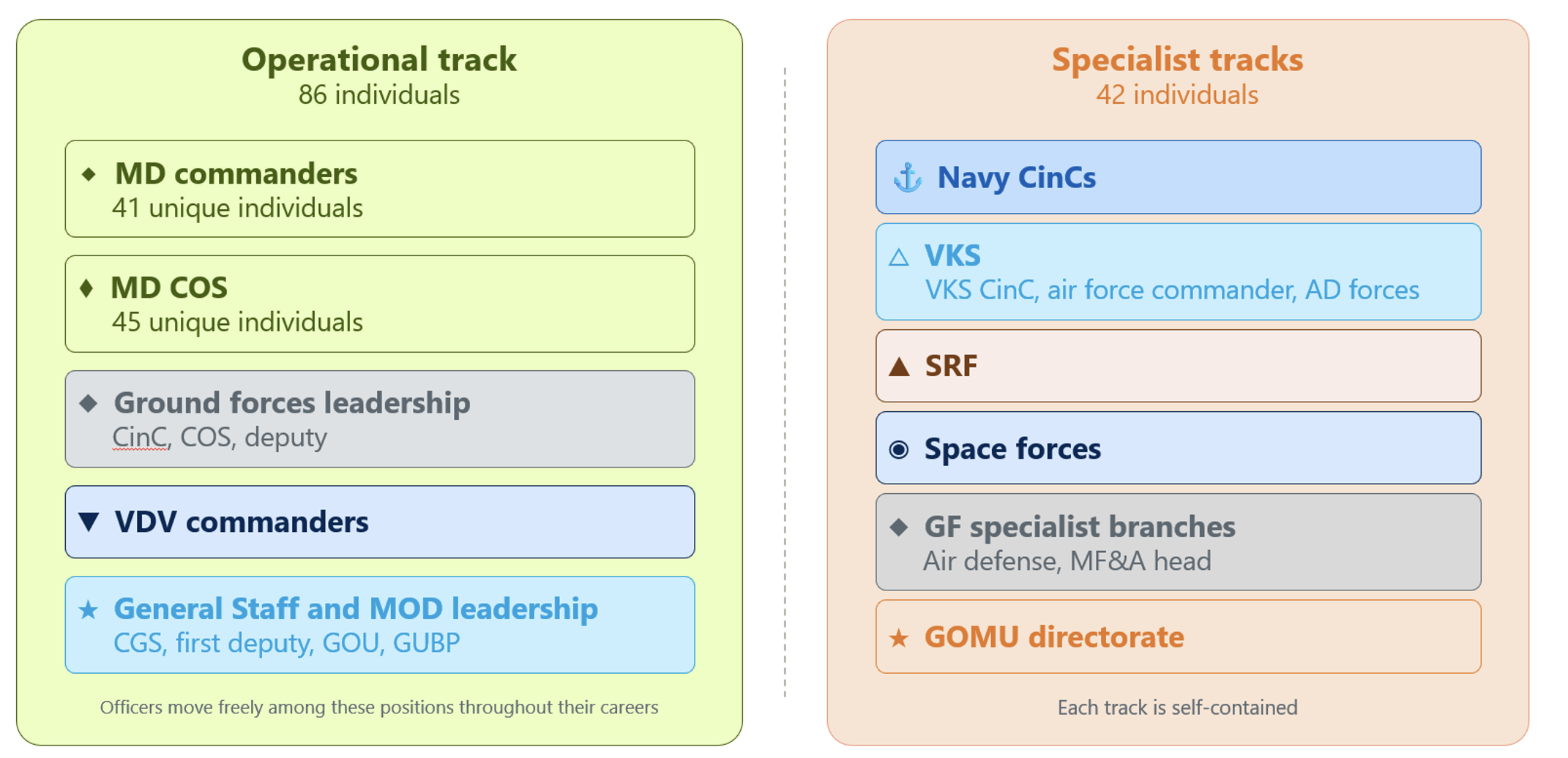
Officers in the operational track frequently hold multiple iterations of the same position type. Lateral repetition at the same tier is valued as a qualification for the next level, particularly in the operational track, in which geographic breadth may be seen as a sign of adaptability. In this track, less glamorous military districts are used as locations to train potential future leaders. Command of military districts well away from combat zones, and especially the Siberian Military District, has been more important than command of military districts closer to the action, such as the North Caucasus Military District. However, this pattern was strongest from 2000 to 2010 when the pre-reform district structure was intact. The 2010 merger of the Siberian Military District into the Central Military District diluted this geographic signal, and the wartime reshuffling has further eroded district-specific career patterns in favor of ad hoc placement driven by operational needs.
Most but not all services have specific lower-level units that are linked to future career advancement. The 58th Army, 20th Army, 41st Army, 36th Army, and 5th Army appear repeatedly in the career histories of officers who go on to military district chief of staff and commander appointments. In the navy, the Northern Fleet and Pacific Fleet account for all early and mid-career development of commanders-in-chief, and the Baltic and Black Sea Fleets serve as senior broadening tours rather than producing commanders-in-chief from scratch. For the Strategic Rocket Forces, the Plesetsk Cosmodrome serves as a key predecessor position to service command. For the air force, air army command in the Far East or North Caucasus is correlated with promotion to service command, though the track record is not as ironclad as for the navy. The other services lack clear feeder units.
Three Years That Changed the Officer Corps
The 2010 reform amalgamated the military districts, largely eliminated same-district chief-of-staff-to-commander succession patterns, and temporarily increased the significance of General Staff experience. The share of military district commanders arriving from General Staff billets jumped from 0 percent before 2010 to 32 percent from 2010 to 2021. It then dropped back to 0 percent during the Russo-Ukrainian war.
The 2015 creation of the aerospace service merged the air force, space force, and air defense systems under a single command, opening the door for a ground forces officer (Sergey Surovikin) to lead an aerospace service. The Syria intervention that began the same year created a new feeder pathway that produced multiple military district commanders. The 2022 invasion compressed tenure lengths, fragmented the senior promotion pipeline, and created entirely new feeder categories, such as Ukraine wartime command and direct army-to-military district commander appointments, while simultaneously freezing the General Staff in place.
The pre-2010 system was decentralized with strong district-specific career ecosystems, and from 2010 to 2021, the system was centralized through the General Staff. In contrast the current wartime system is ad hoc, driven by operational necessity rather than institutional design. The most structurally interesting question for the future is whether the wartime fragmentation of career pathways will prove temporary or permanent. In other words, will the system revert to its pre-war patterns once the conflict ends, or will the war permanently diversify the routes to senior command?
The War, The War, The War
Combat credentials have tended to accelerate promotion. The wartime era has created new feeder pathways into senior command that did not exist before 2015. This shift is exemplified by commanders of forces in both Syria and Ukraine being appointed to command of military districts and to top positions in the ground forces and airborne forces.
Wartime has led to more rapid turnover in operational commands but longer terms in the General Staff. Average military district commander tenure has dropped from 2.9 years before the war to 1.0 years since the war began. Even the maximum wartime tenure of 2.2 years is shorter than the pre-war median. By contrast, the leadership of the General Staff has been entirely untouched by removals since the start of the war (in fact, since 2018), suggesting that Gerasimov may be protecting his subordinates in much the same way Sergei Shoigu protected his subordinates in the Ministry of Defense until he was replaced.
Relatedly, ambitious Russian general officers now have to confront the possibility that they may be removed from their positions for poor performance — but so far, only if they are not in the General Staff, which remains stubbornly immune to any sense of accountability for operational or strategic failures. With only a few politicized exceptions, removed officers have been spared the ongoing purge on the civilian side of the Ministry of Defense and are allowed to retire or shift to a less important position rather than finding themselves incarcerated under criminal investigation.
In addition to these general findings, our data allow us to identify a set of career patterns for Russia’s most successful generals and admirals as they attain the foremost uniformed senior leadership positions in the Russian military (chief of the General Staff and key General Staff directorate heads, service branch commander-in-chief and deputy, and military district commander and deputy). Importantly, such patterns vary by position, rather than having a single, uniform model.
With the patterns we uncovered, we can forecast likely future appointments to top positions so long as previous models of promotion continue to obtain. Naturally, the wartime period may be affecting the nature of appointments, so the patterns of future appointments may vary from patterns derived from peacetime contexts. Additionally, the exigencies of wartime inherently make predictions more uncertain. Candidates who meet criteria for selection may be removed because of operational failures or disagreements with senior commanders, die in battle, or even be targeted for assassination by the adversary. Even with these caveats, this effort is the most sophisticated public effort to track Russian senior officer careers in existence.
Furthermore, appointments over the last four years have shown that previous career trajectories remain broadly predictive for current appointments. What has changed is the rate of turnover and the likelihood that underperforming leaders will be replaced expeditiously or for reasons other than natural, peacetime churn. In other words, while operational necessity has become increasingly common as a driver for replacement of top officers, potential successors continue to be drawn from the types of generals who were in line to be appointed to these positions prior to 2022.
While the specific individuals we identify here, and in our report, as most likely to be chosen may not pan out, others who have followed similar career patterns are quite likely to be selected in their stead. And by following this empirical pattern-model approach, we provide a data-derived baseline for who most plausibly should be promoted, all things being equal, which we can then check against what actually happens in the coming years, providing an unusual ability to test assertions based on real data.
For brevity’s sake, here we discuss predictions for chief of the General Staff, ground forces commander-in-chief, and select military district commanders. Our report also provides predictions for other service branches not included here.
Replacing Gerasimov After All These Years
The path to chief of the General Staff is visibly different and more variable than are paths to positions at the next tier down, such as service chief or military district commander. Gerasimov’s path is illustrative:
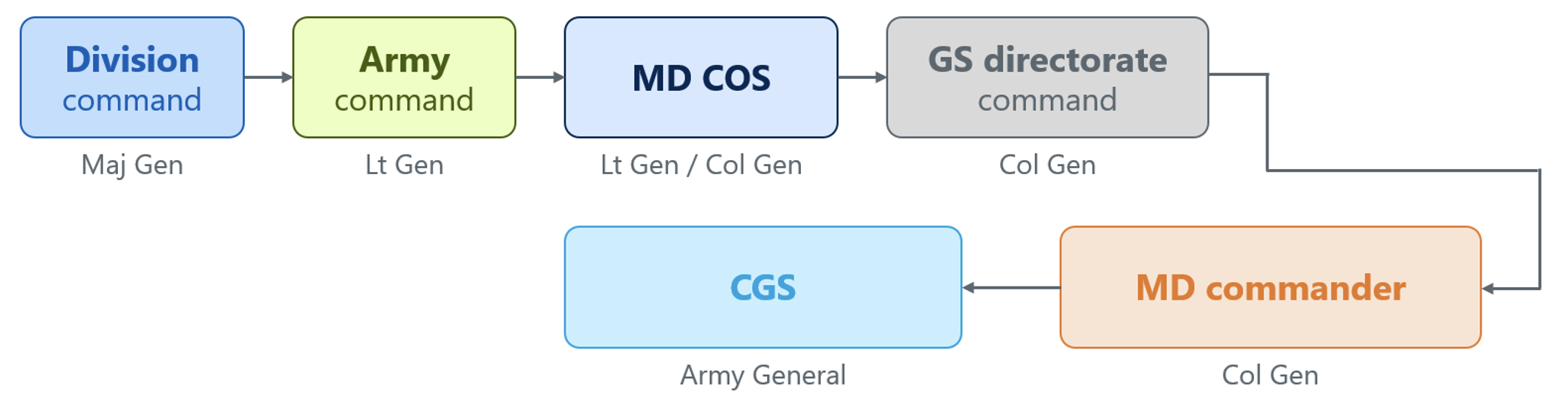
Although only four people have served as chief of the General Staff since 2000, the common thread among holders of this position is not a specific pipeline but an unusual breadth of experience. Chief of the General Staff appointees tend to have both operational field command and central staff experience, a combination that is rare at every other level.
By these metrics, Col. Gen. Aleksandr Chaiko emerges as the strongest candidate. Chaiko’s career closely mirrors Gerasimov’s. He has had two stints as deputy chief of the General Staff, and he previously commanded the 20th Army and the Eastern Military District. He has worked in three military districts and has had four stints commanding Russian forces in Syria. In May 2026, he was appointed commander of the Aerospace Forces, which adds another level of breadth to his command experience. He was the target of an unsuccessful assassination attempt on Aug. 1, 2026, that killed another Russian general and Chaiko’s son-in-law. At 55, Chaiko is in the prime age window for an appointment to chief of the General Staff in the next two to three years.
However, the most likely candidate for appointment may be Col. Gen. Andrey Mordvichev. Promoted to maj. gen. at the extremely young age of 37 (and to col. gen. at 47), he became ground forces commander-in-chief at 49, younger than any predecessor since just after World War II. He has had leadership positions in all four post-2010 military districts, and he commanded the Central Military District before being appointed to his current position. The main uncertainty is that if Gerasimov does depart relatively soon, Mordvichev may be somewhat too young to replace him. However, his fast rise suggests that he could be the youngest chief of the General Staff in modern Russian history and is being groomed for a long term in that position.
Service Branch Commanders: Ground Forces
Past ground forces commanders-in-chief have been highly operationally credentialed. All ground forces commanders-in-chief have a prior history of both army-level command and experience in one of the top two positions in a military district. However, experience in the General Staff is almost entirely absent among this cohort. In other words, this position is viewed as a primarily operational role — one that is earmarked for field commanders rather than staff planners.
Furthermore, ground forces commander-in-chief has generally been a terminal appointment, but that pattern may be shifting. None of the previous ground forces commanders-in-chief moved upward from that position to a higher operational command. Most retired at the conclusion of their terms. However, Mordvichev’s appointment in May 2025 is historically unprecedented, suggesting that for him, this position may become a springboard to appointment as chief of the General Staff.
Although there are several potential candidates, the most promising candidate to succeed Mordvichev as ground forces commander-in-chief is the 53-year-old Col. Gen. Andrey Ivanayev, who has served in four military districts and was just appointed commander of the Central Military District after almost two years commanding the Eastern Military District. He was previously chief of staff of the 36th Army and commander of the 20th Army, both key feeder formations.
Territorial Commanders: The Military Districts
The patterns we identified show that appointment as a military district commander typically requires command of a combined arms army, especially one of the units we identified as common feeder formations, prior service as a military district first deputy commander, experience in three to four military districts, operational experience in the Southern (previously North Caucasus) Military District, combat experience in Syria or Ukraine, and a rank of col. gen. at appointment. The typical military district commander appointee is in his early to mid-50s at appointment.
Based on these patterns, several generals who are or have recently served as military district chiefs of staff are potential future military district commanders. These include 46-year-old Col. Gen. Denis Liamin, who was just appointed head of the Unmanned Systems Forces after a stint as chief of staff of the Central Military District; Lt. Gen. Aleksandr Tokarev, currently chief of staff of the Southern Military District; and Lt. Gen. Petr Bolgarev, chief of staff and (as of August 2026) acting commander of the Eastern Military District.

At the most basic level, this study has shown that long-term patterns are present in the career trajectories of Russian military leaders. Grasping these patterns will help analysts understand the kinds of officers who are most likely to be promoted to senior leadership positions in the future. This, in turn, allows us to identify which lower-tier general officers to track as potential future military leaders. The analytic leverage thus gained has obvious implications for analysts inside Western intelligence organizations as well as for scholars looking at Russian civil-military relations, comparative military organization, and other research portfolios.
Cohorts Shape How Officers Think
The composition of Russia’s military elite in both its upper and lower tiers is characterized by a path of successful promotion that extends from the officer’s time as a midranking officer through initial command experience as a colonel and then passing into the formal corpus of higher officers. The time from an individual entering the ranks of the Russian officer corps to the conclusion of his career as a general officer with at least one star is between 20 and 30 years.
Current leadership is still dominated by those whose background lies in the Yeltsin and early Putin eras and who pursued their early career ambitions before the 2010 reform period. It is not surprising that claims of brittleness and Soviet-informed thinking dominated criticisms of military leadership among Russia’s hawkish war correspondents. As this generation approaches retirement, its members will be replaced by potentially higher-quality officers who joined when the military was expanding and more opportunities were available.
The new generations of Russia’s military elite that are coming up right now are significantly more experienced in complex out-of-area operations (Syria) and protracted conflict (Ukraine) than their current leadership. A new generation of junior officers is forming now, when patriotic attitudes play a major part in decisions to join the military and combat experience is frequent for those who join. The rising general officer of today is simply coming from a different intellectual, cultural, and institutional background than those who currently command him at the strategic and operational-strategic levels.
These generational factors are likely to influence how Russian military leaders view Russia’s position in the world and the role that the military can play in Russia’s foreign policy. Scholars and analysts have long studied the dominance of Russian elites from the security services as key indicators of foreign policy hawkishness. But the Russian military elite, which is normally siloed into a somewhat subservient position in Russia’s civil-military relational dynamic, is also influenced by changing worldview trends. Cohort analysis of Russia’s officer corps will help analysts understand these generational shifts and how they affect the Russian military and strategic culture.
War Shifts Will Outlast the War
Senior officer career patterns are already being affected by the war. Command position churn is higher than the pre-war baseline, the threat of removal for poor performance (real or scapegoated) is now regularly applied to operational commanders, and a new interest in bringing military figures into civilian politics through the Time of Heroes program are all augmentations to traditional patterns in the pre-2020s Russian military.
These effects are certain to continue and likely to increase over the next 10 to 15 years. For the next two decades, we will be dealing with Russian leadership cadres whose careers were strongly influenced by choices made in the early and mid-2020s, in some cases raising people who might otherwise have never achieved high office, in others cutting off otherwise promising careers early. We cannot know exactly how this will shape the next cohort of senior leadership, but we do know the impact is already being felt on career patterns right now. Analysts will need to continue to track how the war is affecting promotion patterns in the Russian military, both as the war continues and after it ends.
Rapid Replacement May Erode Effectiveness
As we have shown, the Russian military senior operational leadership is turning over at an unprecedented pace, with district commanders’ terms now lasting just one year on average. Putin just announced yet another reshuffle in early August. This level of churn may negatively affect military leaders’ ability to perform their duties. Newly appointed commanders are likely to have less experience managing large military bureaucracies, and short terms of service may affect the extent to which they are able to learn their jobs before being rotated.
Fear of replacement or demotion may also affect leaders’ decision-making, potentially making them more cautious about taking risks. In addition, rapid churn may also harm the ability of commanders to develop patronage networks with their subordinates while simultaneously reducing the extent to which subordinates develop loyalty to their superior officers. By reducing the time to invest in trust-building among peer groups, the new military elite will no doubt look very different from the stable cohort under the long Shoigu-Gerasimov tandem that dominated the last 15 years of Russian military leadership.
On the other hand, an unprecedented number of relatively young one- and two-star general officers (and the colonels immediately below them) have gained significant combat experience in Ukraine, and the consistent rotation in operational commanders means that a far more operationally skilled (at least in principle) cadre of elites is now in prime position to move into the highest echelons of the military hierarchy over time. Analysts will need to take into account this changing experiential reality for the Russian military elite — only the U.S. military hierarchy has a comparable breadth and depth of wartime experience.
Dmitry Gorenburg, Ph.D., is a senior research scientist in the Russia Studies Program at the CNA Corporation, a not-for-profit, nonpartisan research and analysis organization based in Arlington, Virginia. He is editor of the academic journal Problems of Post-Communism and an associate at Harvard University’s Davis Center for Russian and Eurasian Studies. He has written widely on Russian military affairs, Russian foreign policy, and the Russian navy.
Julian G. Waller, Ph.D., is a research scientist in the Russia Studies Program at the CNA Corporation and professorial lecturer in political science at George Washington University. He has written widely on Russian political-military affairs, strategic elite decision-making, and authoritarian governance and political order. He is co-author of the book Autocrats Can’t Always Get What They Want: State Institutions Under Authoritarianism.
Gabriela I. Rosa-Hernandez is a specialist in Russia’s security policy in the Russia Studies Program at the CNA Corporation. Her recent research has focused on Russian strategic deterrence, Russia’s military medical service and its battlefield medicine practices, and the military thought of the Russian Armed Forces more broadly. She has significant in-country experience in Russia, Latvia, Estonia, Poland, Georgia, and other countries in the region.
Cornell Overfield is a research analyst at the CNA Corporation who specializes in the relationship between maritime law and foreign policy. His work and writing on U.S. national security strategy, Arctic affairs, and maritime law and law of the sea have appeared in Foreign Policy, The Economist, Politico, Lawfare, and academic journals.
The views expressed here are those of the authors and do not necessarily reflect those of the CNA Corporation, the Department of the Navy, or the U.S. government.
Image: President of the Russian Federation via Wikimedia Commons



_15.jpg)