Join War on the Rocks and gain access to content trusted by policymakers, military leaders, and strategic thinkers worldwide.
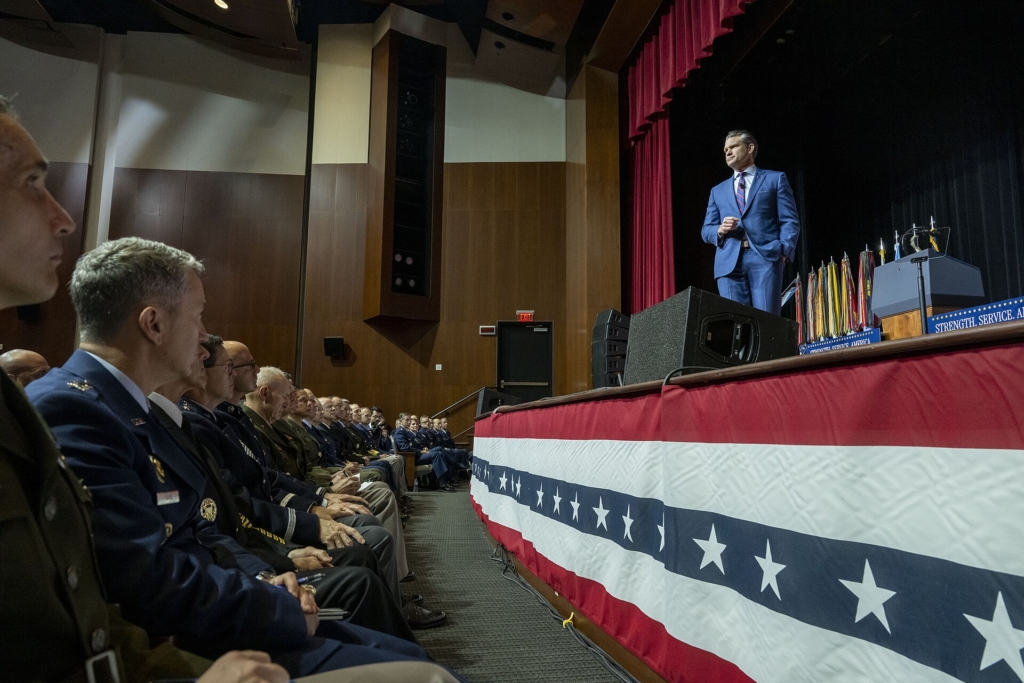
Secretary of Defense Pete Hegseth is expected to convene a high-profile meeting of military personnel for a “State of the Force” address this week. Will it show the U.S. armed forces as healthy? The answer may depend on how the audience responds, regardless of what Hegseth says. How the audience handles what could be one of the higher-visibility made-for-media events of the defense secretary’s tenure could tell us a lot about how the U.S. military has adjusted to President Donald Trump’s second term.
Reporting on the event is spotty, which suggests the Pentagon’s leadership is still deciding whether to hold it, or perhaps simply opting for a lower-key rollout. If it happens, this event will be somewhat like a reprise of last September’s unprecedented all-hands meeting involving over 800 generals and admirals. Like a midterm exam, this event is a moment to assess the performance of military professionals ahead of the Trump administration’s own midterm, the November elections.
The military passed last year’s exam with flying colors. The meeting came as a surprise with very little explanation. In that low-information environment, speculation abounded, and some serious observers worried about a potential crisis. Nothing like that happened, yet what did transpire was a test nonetheless. The assembled were treated to a campaign rally speech by Trump and to Hegseth’s vigorous recapitulation of the main talking points about military fitness, grooming standards, and his “anti-woke agenda” that he had been delivering since he took the job.
For most observers who do not understand American civil-military relations, the headline “President and Secretary Talk About Their Priorities with Senior Military Brass” might sound painfully routine, even banal. Yet this anticlimactic show constituted a serious trial on the crucial question of how the senior officers can maintain the essential nonpartisan ethic of the professional military during a time of intense political polarization and hyperpartisanship. The key was for the military to listen respectfully, but not to cheer the kinds of partisan talking points that are acceptable at political rallies but toxic in a military environment. Earlier that summer, a much more junior audience at Fort Bragg failed a pop quiz when they raucously cheered and booed on cue to the president’s standard stump speech.
Trump is allowed to say it. The military is allowed to think it. But as uniformed members of a nonpartisan institution sworn to uphold the Constitution, the military should respectfully listen and maintain the nation’s trust by not publicly taking sides on partisan issues.
This standard requires military audiences to show some discernment in how they respond to predictable talking points. “Go Navy, Beat Army?” Cheer or boo as you wish. “We will get you a pay raise?” By all means, applaud. “The scumbags in the previous administration were too weak to give you a pay raise?” Stand silent. “We will win the war against Iran?” Feel free to cheer the pep talk if you want. “Politicians and the media who criticize how we are fighting this war are enemies of the state?” Sit silently.
Call this the State of the Union slouch. If you watch the Supreme Court justices and senior military officers in attendance, they are often sitting mutely while the legitimately political members of Congress pop up and down in cheers — or occasionally boos — in response to partisan applause lines. This is how the military should behave when addressed by politicians.
To be sure, a quiet audience could indicate norm observance, or it could be a sign that the audience is scared by the presence of senior leaders, particularly senior leaders who have shown an extraordinary willingness to fire subordinates. Whether a quiet reception indicates a healthy or unhealthy environment is partly a matter of interpretation. But given the pervasiveness of partisan applause lines, a quiet reception is beneficial for reinforcing the norm, regardless of what is driving military behavior. And if reporters ask about the moments of silence, this is a great teaching moment for the public and for the rest of the force to hear about the importance of the nonpartisan norm and why no one should expect the military to be a partisan cheer squad.
This is decidedly not a trifling matter of decorum or politeness. The safety of the American republic and the constitutional order depend on elected political leaders trusting that the military they have inherited from previous administrations will serve in a nonpartisan fashion. The norm of nonpartisanship is enshrined in the Uniform Code of Military Justice and in Department of Defense Directive 1344.10, which strictly limits what uniformed military personnel can say and do when it comes to political speech and behavior. Of course, service members can vote and attend partisan rallies on their own time. But they may not attend rallies in uniform, thus reinforcing the idea that they are acting in a private capacity, not as part of the armed forces. To be sure, the directive does not address the specific circumstances that arose at last year’s events, when the military was ordered to attend in uniform and then subjected to a campaign rally-type speech. But the senior audience at Quantico showed how to behave in that ambiguous setting, and it was a powerful teaching moment for those who observed it.
Of course, the military can hold private views about political leaders, but the kinds of contemptuous speech directed at political leaders that are commonplace on social media can be a violation of Article 88 of the Uniform Code of Military Justice if uttered by a uniformed officer against a wide range of political figures from the president to members of Congress or even to state-level political leaders.
The norm of nonpartisanship is reinforced in various professional military education engagements as service members move up the promotion ladder. The norm is considered so important there is even an active debate among civil-military specialists and the most senior military leaders as to the extent to which the norm extends or should extend into retirement.
The more visibly the military behaves in a partisan fashion, the harder it is to establish the trust on which healthy civil-military relations depend, and the more pressure the next administration will feel to clean house by ridding the ranks of partisan supporters of the last administration. Already, incoming political appointees face a temptation to wrongly label as “partisan” a military member who merely executes or implements a policy developed by the previous administration that the new team wants to change. If the military blurs that distinction by seeming to be cheerleaders, it invites an overcorrection. Once that pendulum is set in motion, it is very hard to stop. As other leaders who have conducted political purges of their armed forces have discovered, the result can be disastrous to military effectiveness.
At last year’s Quantico event, the audience met the test perfectly. They listened respectfully and gave no partisan response even when the speakers invited them to do so. The audience at the upcoming meeting should at least match that performance. Anything less stoic will be seen as slippage and a creeping politicization of the force.

This high standard will be hard to achieve for at least two reasons.
First, we can’t expect civilian leaders to help the military maintain decorum. While specialists praised the civil-military decorum at last year’s event, neither Trump nor Hegseth did. The president even commented on the quiet in quizzical terms, clearly preferring the more raucous reception he regularly receives from the partisan audiences that attend his rallies by choice — unlike the Quantico audience that was ordered to attend. To my knowledge, Hegseth did not praise the generals, admirals, and senior enlisted leaders — nor, to be fair, did he publicly criticize them for being quiet — and expressed no concerns about putting military audiences in these fraught partisan settings. Will the civilian team arranging the upcoming event show a sensitivity to these concerns, or will it look for ways to deliver more of the campaign rally mood that makes for politically useful video clips?
Second, the audience at this year’s event is expected to be significantly more junior in rank and experience. Younger officers and enlisted troops have not been as steeped in civil-military norms, expectations, and best practices as the more senior ranks are. They may not fully understand or embrace the norm of nonpartisanship that is required of them. Very likely, someone reminded the assembled generals and admirals of the nonpartisan norm and the importance of avoiding the appearance of politicization. Whoever did this was preaching to the choir, since most in the audience already understood this. By contrast, the new audience will have spent less time thinking about this aspect of the professional ethic and so will require a stronger reminder — and without it could be more vulnerable to a misstep. That said, the younger audience could be an advantage in one respect. If Hegseth gives essentially the same speech to this new audience that he gave last time, it might land better. Certainly the junior officers and noncommissioned officers expected at the new gathering are more at the stage of their career where attention to fitness still is paramount. A backward-looking speech on these reforms would be well received, provided that it is not larded with partisan attacks. If it contains the latter, who will give the reminder message to the rank and file about how to remain nonpartisan this time?
Getting the more junior audience to meet the strict standards of the professional military ethos will be a leadership challenge for a force that has lost many of its most respected military leaders over the last year. The highest leadership levels of the Army, in particular, have been hollowed out with the loss of the service secretary, the chief of staff, and many of the most experienced combat leaders who have ably modeled nonpartisanship.
These challenges lead to obvious prescriptions. First, Hegseth should show he understands and values the norm of nonpartisanship and should include that support in his remarks. Critics of the secretary may doubt he would deliver such a message, but a nonpartisan military that is trusted to support the political leadership is a crucial component of military professionalism, which is a vital part of the military effectiveness Hegseth has championed. Second, the senior military leadership and the chain of command of all members of the audience should remind the attendees of this bedrock principle and how to manifest it in this setting. We will see whether service leaders can get a much less prepared cohort to meet the exacting nonpartisan standard that previous military leaders thought essential and that the force has demonstrated through its history.
Hegseth is right to want to communicate his vision to the uniformed military he leads. A substantive policy speech addressing the myriad challenges the military faces and conveying Hegseth’s plan for overcoming them would be well received and win plaudits, even from critics. But a partisan diatribe would be worse than a missed opportunity: It would put the audience in a position where pleasing the boss undermines their professional ethic, something the best Pentagon leaders try to avoid. And if the military audience fails that test, it could intensify concerns about the health of the military professional ethic at a particularly fraught moment in American civil-military relations.
Peter D. Feaver is a professor of political science and public policy at Duke University, where he directs the American Grand Strategy Program. He is the author of Thanks for Your Service: The Causes and Consequences of Public Confidence in the U.S. Military (Oxford, 2023).
Image: U.S. Secretary of War via Wikimedia Commons
**Please note, as a matter of house style, War on the Rocks will not use a different name for the U.S. Department of Defense until and unless the name is changed by statute by the U.S. Congress.



.jpg)